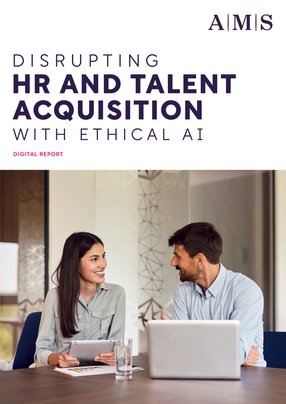
AMS: Disrupting HR and Talent Acquisition with Ethical AI
AMS is a global talent solutions business, providing talent acquisition and talent consulting services to some of the world’s most admired brands across permanent, contingent and early careers hiring.
The company combines expertise in talent acquisition with AMS One – its AI-enabled orchestration platform – to connect processes, people, data and technology for faster, better hiring decisions.
Alan Segal, Chief Digital & Technology Officer at AMS Solutions (AMS), leads the strategy and delivery for technology platforms and AI-enabled services across the global talent acquisition and HR firm.
Since joining the company, Alan and his team have overseen what he describes as a significant digital evolution that has improved AMS data-enablement and agility.
With AMS One at the centre of a unified data and AI strategy, access to the right data at the right time is helping AMS’s experts find high-quality talent for their clients with greater speed and efficiency.
AMS provides global workforce solutions supported by its AI-enabled platform
AMS is a global partner in talent acquisition and workforce solutions. The company helps organisations design and deliver hiring and mobility outcomes across permanent hires, contingent workforce and early careers, as well as skills creation.
“Our mission is all about helping clients thrive by integrating people, processes, data and technology, meeting them where they are and orchestrating value across their existing tech ecosystem, reducing friction and increasing agility,” Alan says.
The company operates on a philosophy it has branded as People powered partnership, which Alan describes as integral to AMS and what it does. The approach blends domain expertise with technology and AI while keeping human judgement at the centre.
“People powered partnership – it's a brand, it's a statement and it's integral to who we are and what we do,” explains Alan.
“Human judgment stays at the centre, while we augment with AI that allows us to deliver at scale, speed and consistency. It means teams spend more time on what matters: people.”
AMS driving system-level change in talent acquisition
The shift in how AMS deploys AI represents a departure from what Alan sees as the prevailing approach in the market. While AI has accelerated the development of software and tools, many remain focused on what he terms point-level augmentation. AMS has taken a different path.
“What we've done is taken a step back. We've considered how we drive deeper relationships with our clients, continuously add value and develop the use of AI to deliver that impact," Alan says. “What we came up with is the ability to provide a system-level change to talent acquisition.”
This system-level approach involves orchestrating all components within talent acquisition into a single unified platform, a middle-ware that maximises the investments our clients make in their tech stack.
AI enables the company to drive automation of routine steps, surface insights in the flow of work and improve decision quality. The focus on orchestration addresses what Alan identifies as a persistent problem in enterprise environments.
“Enterprise organisations maintain several tools and technologies that are being used to deliver a single outcome, which could be a step in the recruiting process,” Alan explains. “Orchestrating and unifying all those outcomes, as I continue to see, is the number one trend that's shaping our space.
“In discussions with our clients, we discuss how AI can support attraction, screening, coordination, interview scheduling and insights. These are point level tasks,” says Alan. “These capabilities are stitched together within AMS One, providing a system level experience that improves consistency, fairness and throughput while maintaining human oversight and quality of hire.”
Talent acquisition primed for AI disruption in HR industry
According to Alan, HR ranks in a high percentile when measuring areas where AI can influence corporate environments. Within HR, talent acquisition represents a particularly ripe area for disruption.
"It's an area that's been largely unchanged for many, many years, and now's the time to disrupt it with AI," Alan says.
The focus on tangible outcomes at AMS distinguishes the company’s approach as truly transformative, beyond what Alan describes as “AI hype”.
AMS concentrates on metrics including time to fill, quality of hire, cost to serve and experience scores. Every capability shifts with adoption plans, controls and reporting so clients see outcomes rather than features.
The company helps clients adopt skills-based practices, unified analytics and adaptable operating models that flex with demand. This flexibility holds particular relevance given current economic conditions, where micro and macro changes continue to influence workforce planning.
“It is such an important time for innovation in HR and talent acquisition in our current environment. The influences of micro and macro changes are still being felt on many levels, and being able to flex on demand is a critical value proposition. I believe that is what we bring to our clients," Alan says.
AMS partners with Endava and FOIL for technology and AI development
The partner strategy at AMS operates on an outcome-first basis. The company integrates with best-of-breed solutions through open APIs and co-innovation, with a focus on speed to value, security and client outcomes. Partners include Endava and FOIL, which serve different functions in the company’s broader ecosystem.
FOIL operates as an AI partner, working with AMS on the evolution of AI development, framework management, deployment, education and outcome-based values from a training perspective. The partnership provides external validation and maintains focus on ethical AI deployment.
"We do that specifically so we ensure that we have outside third-party lenses to keep us honest and accurate in our endeavours, and all of that is supported by industry certifications that are embedded into our strategy also," Alan says.
These certifications are designed to ensure the company remains focused on ethical and responsible AI deployment. AMS has launched an ethical AI board and released the first charter for the use of Ethical AI in Talent Acquisition earlier this year.
“Our board includes members and partners with deep industry expertise to address ethics within AI, and its application to talent acquisition as a whole, covering key themes like bias detection,” Alan says.
“Endava functions as a technology partner, helping AMS build ecosystems to support the technology delivered alongside clients,” explains Alan. “Our partner approach allows clients to keep their systems of record while AMS orchestrates value across their technology stack.”
Five trends shaping talent acquisition technology over the next 12 months
The pace of technology and innovation has compressed strategic planning horizons. Where companies once built strategies for three, five or seven years ahead, Alan admits there can be challenges planning further than 12 months ahead, given the pace at which technology is changing daily.
Nevertheless, he identifies five trends shaping the talent acquisition space in the coming year.
- Orchestration platforms are unifying fragmented talent acquisition stacks.
- Skills-based hiring and mobility are reshaping workforce design as roles evolve and organisations focus on internal mobility.
- Digital agents are moving from pilots to production as companies seek real value from AI after years of experimentation.
- Data products and real-time analytics are driving decisions as organisations place greater trust in outcomes from datasets.
- Trust, governance and responsible AI are becoming differentiators rather than afterthoughts in vendor selection and deployment.
"Everyone's had a couple years to play and get comfortable, now they want to see real value from AI," Alan says.
AMS has expanded AMS One as a workflow optimisation platform for talent acquisition..
“Looking ahead, we will scale digital agents with guardrails, drive outcomes-based services across hiring types and different markets and continue supporting our clients towards skills-based hiring with AI augmentation,” says Alan.
“Digital twinning, as an example, is another hot topic at the moment. This entails using a dynamic, virtual model of a candidate or job role using real-time data (skills, behaviours, performance) to simulate potential job fit. With this, you benefit from predictive insights for success and how to optimise the hiring process. This is a move beyond the traditional resumes to offer an objective, providing data-driven matching and risk-free scenario testing for better recruitment outcomes. Beyond this, it’s then a question of how AI can actually help augment roles and needs that the clients are looking to fill as well.”
Company portals
Executives
Alan Segal
Chief Digital and Technology Officer