
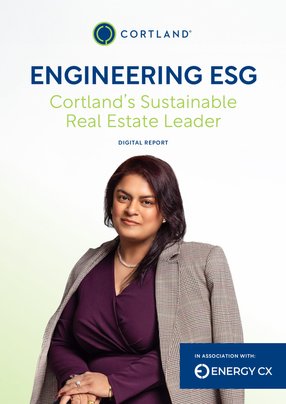
Engineering ESG: Cortland’s Sustainable Real Estate Leader
Yasha Chaturvedi's journey into sustainability leadership began in STEM. Starting as an electrical engineer, she initially focused on designing and optimising systems, but as her career progressed, she recognised a broader opportunity. "I realised that I like to create solutions which are more robust and scalable in nature," she explains.
Today, as Director of Sustainability at Cortland, Yasha advances enterprise-wide environmental, social and governance (ESG) initiatives for the real estate investment firm. Her role reaches across decarbonisation strategies, responsible investment alignment and ensuring the portfolio delivers measurable sustainable outcomes. It is a position that requires bridging technical expertise with strategic vision. It also demands the ability to translate complex data into actionable plans that align with both environmental goals and financial performance.
Yasha's engineering background is invaluable in this role. Her technical training has equipped her with analytical skills and systems thinking. “The quality I lean on most is turning complexity into clarity showing how sustainability and financial performance reinforce each other,” she says.
Her path from clean technology to real estate was driven by a realisation. Whilst working in New York after relocating from the West Coast, she saw that buildings represented the highest source of emissions in the city. Yasha feels that “real estate is where climate change meets daily life, giving us the chance to turn every building into part of the solution”. This presented both a challenge and an opportunity.
“Diverse leadership is essential to building sustainability strategies that are both resilient and inclusive,” Yasha says. She serves on the Advisory Board for Women in Leadership at the University of North Georgia. This role allows her to support emerging women leaders and help create confidence that complex, non-traditional career paths are achievable. “For me, it’s about lifting others as we rise and ensuring the next generation of women leaders not only has a seat at the table, but the confidence and support to drive lasting change," she explains.
"Aligning building performance with financial strategy to create sustainable solutions that reduce emissions is not only an environmental decision but also one that promotes health and well-being," Yasha says. The multifaceted impact of improving building performance, as well as environmental, financial and human elements, convinced her to commit to the built environment. She found herself drawn to an industry where sustainability strategies could create tangible, measurable outcomes for communities.
"What inspires me today is urgency," Yasha says. Climate change impacts are no longer confined to specific regions or distant futures. They are being witnessed globally, in real time. "It reaffirms and reassures us that every single step forward is very deeply important," she adds.
Yasha also serves on the Advisory Board of Bold Impact ATL, a network of changemakers shaping equity, leadership, and sustainable growth across Atlanta. With the World Cup coming to the city in 2026, Bold Impact’s SustainTheGame™ initiative aims to highlight Atlanta’s growing role in sustainability and global collaboration – an effort Yasha supports by fostering innovation, partnerships and community resilience.
As Atlanta prepares to welcome the world, its sustainability journey offers an inspiring example of how local leadership can ripple into global impact. “It’s about empowering people to lead, collaborate, and build systems that endure,” she says."
Bridging ambition with operational reality
The biggest challenge Yasha faces in her role is bridging ambitious goals with operational realism. Bold ESG commitments can inspire progress, but delivering them means navigating practical constraints: limited budgets, legacy systems, data limitations and changing compliance requirements.
For the real estate sector, these complexities open pathways to reimagine how we build and operate. "Sustainability goals are long term in nature while the business is short term," Yasha explains. She feels that the solution lies in breaking down larger ESG goals into scalable steps that align with business practices and create momentum. "We can create slow steady progress today and that becomes a much larger impact for tomorrow," she says.
Collaboration is essential to overcoming these challenges. Yasha says that her effectiveness depends on working closely with subject matter experts and business leaders across the organisation. Understanding their day-to-day challenges and co-creating solutions leads to outcomes that are more durable, impactful and resilient. She says that "building bridges and not walls" is the best advice she has received.
Cortland, a multifamily investment, development and management firm, provides various integrated services. These include investment and acquisition, new development and renovation, asset and property management and investment management for various funds. The firm's vertically integrated structure allows it to maintain control across the entire asset lifecycle. This integration supports a more consistent approach to embedding sustainability.
Yasha says: “Buildings carry a profound carbon impact and they’re also where people spend their lives. Aligning performance with finance means healthier, more resilient communities.” As Yasha explains, sustainability should be "integrated to help align our approach with best practices while remaining mindful of human impact.”
Building momentum at Cortland
Cortland has expanded its sustainability programme, strengthening its ESG performance and achieving top-tier GRESB ratings for two of its flagship funds. The company has also aligned its investment strategy with the United Nations Principles for Responsible Investment (UNPRI), reinforcing its commitment to responsible investment practices.
“Sustainability has moved from being a supporting element to becoming a driver of resilience, performance and community impact,” she explains.
Yasha says she is particularly proud of moving from strategy to action. In 2023, Cortland launched a company-wide greenhouse gas (GHG) inventory to track emissions across Scopes 1, 2 and 3 marking a major step toward transparent, science-aligned climate action.
Becoming an ESG leader
Yasha focuses on connecting financial performance with real-world impact. She believes sustainability works best when it’s built into everyday decisions rather than treated as an add-on. Her approach brings together investment insight and operational action, ensuring that ESG principles guide both strategy and execution. “Combining financial and operational decisions so that sustainability and performance go hand in hand,” Yasha says. For her, leadership in ESG is about being consistent, transparent and forward-looking, turning long-term goals into measurable results.
Technology plays an important role in this process. Data platforms enable more seamless data collection, reducing the burden on subject matter experts. Once collected, modelling tools provide realistic understanding of performance across the portfolio. As Cortland moves into the next phase of creating decarbonisation strategies, technology helps evaluate which pathways would work best from both performance and financial perspectives.
"Technology is playing a part in every single stage and process at this point," Yasha says. “It helps us to connect ambition with action.” This includes everything from initial data capture through performance analysis to strategic scenario modelling.
The role of energy in sustainability
Energy and utilities are integral to building operations throughout their lifecycle. The challenge is considering all these aspects whilst reducing risk over time.
Yasha says: “Partnerships are at the heart of sustainability. We cannot solve the challenges of decarbonisation, climate risk or community resilience alone. It takes collaboration bringing together diverse expertise, aligning interests and building momentum collectively. Partnerships turn ambition into action, and action into impact.”
True progress happens when industry, policymakers, investors and communities work in sync. Collaborative ecosystems accelerate innovation, enable data transparency and ensure equitable outcomes. Whether it’s scaling retrofit solutions, aligning capital with sustainability goals, or creating pathways for circular economies, partnerships are the connective tissue that drive transformation. In today’s complex landscape, no single entity holds all the answers, but together, we can build solutions that are both resilient and regenerative.
From strategy to execution
Looking ahead, Yasha's focus is moving from strategy to execution. With the foundation set through decarbonisation planning and responsible investment alignment, attention is turning toward identifying and advancing scalable initiatives across the portfolio. This includes integrating climate risk assessments, testing innovative technologies and strengthening how ESG data informs both operational and investment decisions. “Ultimately, it’s about turning long-term commitments into measurable progress,” she says.
Yasha anticipates a range of changes in industry trends. Transparency and accountability requirements will continue to grow, with disclosure expectations rising. Reporting to frameworks like GRESB and alignment with building performance standards across portfolios will become more important. Building performance standards, which set minimum energy or emissions requirements for buildings, are being adopted in various jurisdictions globally.
There is a growing focus among investors on understanding the relationship between ESG practices and financial outcomes. The question is no longer whether to pursue sustainability, but how to do so in ways that deliver both resilience and returns. Yasha feels that better technologies and more integrated strategies make this alignment more achievable.
“I believe innovation, from new technologies to creative partnerships, will be key to scaling solutions in ways that are both practical and impactful,” Yasha says. “Real estate is right at the centre of the climate challenge, which means it can also be a big part of the solution.”