
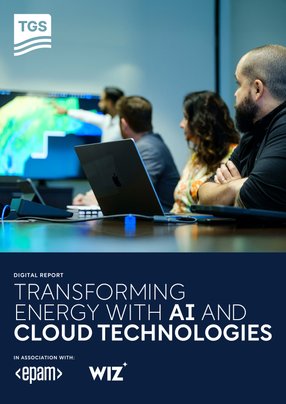
TGS: Transforming Energy with AI and Cloud Technologies
As demand for energy rises and the industry faces increasing pressure to operate more efficiently, companies are turning to AI and cloud technologies to transform their operations.
At the forefront of this transformation is TGS, the world’s largest energy data company. The company has built its business on acquiring, processing and selling subsurface data to help oil and gas companies make informed investment decisions. Under the leadership of Wadii El Karkouri, Executive Vice President of Imaging & Technology, TGS is evolving from a seismic company enabled by technology into something far more ambitious.
“We’re turning it into a technology company enabled by seismic data,” Wadii explains.
Wadii joined the business in 2024 from AWS following a career predominantly at the intersection of energy and technology, with more than two decades at SLB preceded by a stint at TotalEnergies. His appointment represents a strategic bet on the convergence of energy expertise and digital innovation.
To underpin this shift, TGS has acquired numerous competitors over the last four decades, creating what Wadii describes as “pieces of Lego” – technology, people, knowledge and experience – that must be brought together.
TGS operates through four main business units. Its seismic data acquisition division owns expensive vessels worth up to US$250m each that collect subsurface data using either streamer technology or ocean bottom nodes.
The processing and imaging division transforms raw seismic signals into three-dimensional subsurface maps, while a multi-client business model involves investing company funds to acquire data, then selling access to multiple energy companies.
The fourth and final division focuses on renewable energy, including wind farm site characterisation and solar asset management software – diversification that reflects the industry’s broader energy transition while maintaining focus on traditional hydrocarbon exploration.
Bridging gaps with technology
One of Wadii’s primary challenges involves bridging the generational divide within the oil and gas industry – a space that has been slow to adopt digital innovations.
His goal is to create a new generation of “oil and gas explorers and producers that are thinking digitally from the beginning”.
The challenge extends beyond individual attitudes to systemic issues within the energy sector. Wadii explains that economic cycles have become more frequent and volatile, forcing companies to deliver faster returns on technology investments.
“The return on investment of R&D and technology is not the five to seven years that it was when I joined the industry,” he says. “It’s now more like 12 to 18 months.”
The impact of revolutionary data processing capabilities
TGS’ technological advantage begins with its massive subsurface data library, accumulated over the course of 44 years of global operations – something Wadii compares to Google Maps, but instead for underground geology.
The extensive dataset enables TGS to develop what Wadii calls a “seismic foundation model” – essentially a Gen AI chatbot for subsurface exploration. The system can identify patterns and connections across different geological basins worldwide.
This level of knowledge and interconnectedness traditionally only existed in the minds of experienced geologists with decades behind them. But, now, the foundation model aims to democratise this expertise, making sophisticated geological insights available through AI.
This, Wadii hopes, could accelerate discovery rates – all while reducing the industry's dependence on scarce human expertise.
The technical process begins at sea, where TGS vessels acquire data using airgun sources that generate sound waves. These waves travel through subsurface layers and return to sensors, creating detailed underground maps.
Modern satellite technology – including Starlink low-orbit systems – now enables real-time data transmission from vessels to cloud processing centres. This represents a significant improvement over previous methods, which involved transferring physical storage devices via helicopter.
How cloud computing transforms imaging capabilities
Once this data reaches the cloud, TGS applies advanced processing techniques to clean signals and remove various types of noise. Sophisticated imaging algorithms are then employed to convert time-based signals into depth-based geological maps.
Two key technologies – elastic full waveform inversion and reverse time migration – use intensive computational power to create accurate subsurface images. These techniques can reveal complex geological features like salt formations, faults and reservoir channels.
Wadii shares: “Because of advances in AI and digital technologies like the cloud, we are able to push the physics of imaging to a level never seen before, allowing energy companies to make better decisions, calculate ROI on their investments in drilling a new well or investing in new prospects and, hopefully, leading to better discoveries and more energy for the world.”
This shift does not come without challenges, however. The sheer volume of data TGS processes means careful organisation and standardisation is required. Wadii, using Netflix as an analogy, explains the need for consistent data formats that enable instant playback – like that of streaming services – to ensure the approach works.
“Because Netflix was near enough born on the cloud, all its movies are in the same format,” he explains. “When you subscribe and log in, things play at the touch of a button. But imagine Netflix was born 50 years ago and they acquired Blockbuster and data on tapes – they’d have a mixture of formats. It would’ve been a huge amount of work to get to where they are today, or reformatting all that content probably wouldn’t have even been possible.
“The journey we’re going on is similar. We’re working on tidying up all our legacy data and bringing them onto the cloud so that we can enable new workflows that will generate value for our clients. This is a challenge we want to overcome for ourselves as TGS, but we also offer this as a service to various energy companies. We have contracts in place with large energy companies to support them through this process.”
Strategic partnerships drive innovation
TGS’ digital transformation relies heavily on strategic partnerships across the technology ecosystem. The company works with cloud providers Google Cloud and AWS to modernise its IT infrastructure and processing capabilities.
EPAM, a global IT services company, serves as TGS’ primary systems integrator for workflow modernisation and architecture updates, while cybersecurity firm Wiz monitors the company’s cloud footprint against potential threats.
“The oil and gas industry is always a target for various malicious organisations,” Wadii shares, emphasising the importance of collaboration and partnerships. “We have to make sure we are top-notch, and these partnerships do that.”
On top of this, Wadii and TGS worked tirelessly to achieve the ISO 27001 certification, demonstrating robust cybersecurity practices to clients and partners “and readiness in case such an event happens”.
These partnerships reflect a broader industry trend toward collaboration between traditional energy companies and technology specialists. Wadii emphasises that this is because no single organisation – even one like TGS with decades of specialised expertise – possesses all the knowledge needed for comprehensive digital transformation.
TGS also participates in industry standards initiatives like the Open Group OSDU Forum, aiming to create common data formats and exchange protocols across the energy sector.
What’s more, TGS has contributed its MDIO streaming format as open-source software, enabling efficient data access without creating multiple copies.
Emphasising responsible AI implementation
As TGS deploys AI across its operations, the company has developed comprehensive governance frameworks for responsible AI use. This includes policies balancing innovation with data protection and regulatory compliance requirements.
“We’ve developed a Gen AI policy that ensures AI is deployed responsibly, balancing innovation with controls around data use, IP protection and regulatory compliance,” Wadii reveals. “Beyond policy, we are embedding AI into workflows in a controlled and transparent way, for example, assisting teams with efficiency and innovation while maintaining clear boundaries around confidential and sensitive data.
“Our communications on AI emphasise not just compliance, but also how AI is a transformative enabler for operational efficiency, integration post-merger and accelerated insight delivery for clients.”
Security considerations are built into TGS’ cloud migration strategy from the outset. As the company moves high-performance computing workloads from on-premises systems to AWS, it implements cloud-native security controls and zero-trust principles.
Given the sensitivity of seismic and subsurface data, TGS treats cybersecurity as integral to business continuity and client trust rather than merely an IT function.
The importance of industry collaboration
Beyond technology partnerships, TGS maintains extensive relationships with universities and research consortia. These collaborations provide access to cutting-edge research and insights from other industries that could benefit energy exploration.
Wadii sees potential for cross-industry knowledge transfer, where subsurface expertise could generate value in manufacturing, sports and other sectors.
“That’s never been done before, as far as I know, in our industry,” he says.
The company also works closely with governments worldwide, helping develop local capabilities and organising regulatory frameworks for energy block auctions. TGS invests hundreds of millions of dollars acquiring data in various countries to help market their hydrocarbon potential.
As well as this, client relationships remain central to TGS’ strategy, with regular discussions with major energy companies including ExxonMobil, Chevron, Saudi Aramco and Petrobras. These conversations, which happen regularly, help TGS understand industry priorities and budget constraints.
Wadii continues: “We like to make sure we understand what their priorities are, what their challenges are, what they're trying to achieve in the next 12 to 24 months and how their budgets align with their aspiration so we can discuss how we can use technology, data and knowledge to help them get the maximum return. That’s the key item today.”
The future of energy exploration
Wadii envisions TGS enabling the energy industry to achieve efficiency improvements comparable to those seen in finance, pharmaceuticals and manufacturing through digital transformation.
The company’s mission focuses on driving “vital data-driven solutions and knowledge for society's evolving energy needs” and, with the world’s population approaching eight billion people and energy poverty affecting roughly one billion, demand for all energy sources will continue growing.
“We need all sources of energy to contribute to this energy portfolio – whether it’s oil and gas, wind, solar or hydrogen,” he explains. “There are a lot of other things that are still in research that will be able to enable this energy for the future of society. We need technology and data so we can invest the right amount of money in the right places and get the best return – all with minimal carbon footprint.”
This balanced approach recognises both the ongoing need for hydrocarbon resources and the importance of renewable energy development. TGS’ diversification into wind and solar markets reflects this comprehensive energy strategy.
TGS aims to continue growing while helping transform upstream workflows to be “better, faster and much more cost effective than today”. Success requires integrating technology, human expertise and comprehensive subsurface data to enable better energy discoveries.
“We hope to be able to completely change the oil and gas and the energy industries going forward,” Wadii concludes.
Company portals

Executives

Wadii El Karkouri
Executive Vice President - Imaging & Technology