
MWC 2026: How PITC Leads Digital Change for Pakistan’s Grid

At MWC 2026 in Barcelona, digital transformation dominated discussions across industries – and energy was no exception.
For Pakistan, the change is not just about connectivity or convenience but national power stability.
Muhammad Kashif Shahzad is CEO of Power Information Technology Company, more widely known as PITC. One of Pakistan’s power sector’s 26 entities, it provides IT services and technology solutions to the public sector.
And, as part of the Ministry of Energy’s Power Division, PITC has become an integral part of the digital backbone of Pakistan’s electricity ecosystem.
The firm’s payments systems – particularly its billing technologies – have played an important role in its rise.
“Most of the IT solutions that we have developed so far include the billing system – it’s an indigenous solution we have built, and it runs the billing of 35 million active consumers per month,” Dr Kashif says”
But PITC’s platform doesn’t stop at billing.
The company has created an integrated CRM and consumer e-services hub that digitises everything from technical fault reporting to new service requests.
“We have also implemented AMI – automated metering infrastructure – and we provide the Ministry of Energy and other stakeholders with monitoring of the power sector, the financial health of the power sector,” Dr Kashif says.
“This helps them to perform modelling and simulation to carry out sensitivity analysis of policies the government is considering implementing for the people of Pakistan.”
Moving toward smart grids and DER integration
With renewable penetration rising, managing distributed energy resources (DERs) is crucial, Dr Kashif says.
“Pakistan’s target is to have 30% DER integration,” he says. “The problem we are facing is reverse energy flow, which destabilises the national grid and can lead to a cascade shutdown of the system for security reasons.”
At MWC, Dr Kashif’s main takeaway was finding out what can Pakistan learn from its global peers.
He continues: “What we have learned from our peers is how to carry out feeder switching with load in real time. Our AI projections allow us to predict when demand increases, so we can increase generation accordingly.
“And when there is more energy going back into the system from DERs rather than being consumed, we can facilitate that exchange among households.
“Ultimately, this means moving towards smart grids and micro-grids at the transformer level.”
Learning lessons from China’s digital energy journey
Partnerships with China have accelerated this transformation.
“With China, we have sought their help to understand how they achieved that digital transformation,” Dr Kashif says. “They adopted automated metering infrastructure, which is the basic backbone. Data is at the foundation of everything, including all AI-driven solutions.”
This was a journey that started in 2007 and, by 2015, China had standardised the technology and rolled out AMI metering at scale.
Dr Kashif adds: “What we have learned from them covers several steps: Number one is standardisation, two is cybersecurity, and then third is moving towards digital transformation – the AI layer – in order to build an automated business.”
To continue learning from China and enacting teachings across Pakistan, Dr Kashif is keen to leverage the China-Pakistan Economic Corridor (CPEC), but he wants to go beyond infrastructure.
“At present, CPEC is primarily focused on manufacturing and construction, including road infrastructure to cut transport fuel costs,” he says.
“But if CPEC were also intended to deliver more technology-oriented joint projects with the Chinese government, that would be very valuable – the reason being that China’s utility sector is entirely state-owned, which is exactly the same model as Pakistan’s.
“So if, under CPEC, we could have knowledge-sharing workshops to exchange ideas specific to the energy sector, that would be more targeted and productive than a general display of AI-driven or physical solutions.”
The balance between open data cybersecurity
That same dual focus now underpins Pakistan’s own strategy.
Under the leadership of the Ministry of Energy’s Power Division, PITC is balancing open data sharing with enterprise-grade protection.
“The Minister of Energy has been very open on data,” Dr Kashif says.
“He has said that all research institutions, government agencies – whoever wants the data – we should provide it. Our open data sharing policy has already been implemented.”
For the country’s state-run energy ecosystem, this policy seeks to spark collaborative innovation while maintaining rigorous governance over critical infrastructure data.
He adds: “We not only provide them with access, but we also educate them on what the data means in order to enable meaningful analysis and decision-making.”
At the technical level, PITC has modernised its cybersecurity architecture with enterprise-grade protection from Trend Micro.
“We have implemented a Trend Micro solution, which is a three-layered cybersecurity solution covering EDR, server security, and network security,” says Dr Kashif.
This integrated model provides continuous monitoring and rapid response capability across all power sector entities.
He adds: “Whenever there is a cybersecurity threat it performs threat intelligence analysis, quarantines the traffic, records all changes made to our data and then presents us with the case after stopping the threat.
“We have also implemented a proper cybersecurity governance framework – not only technical controls but also 21 policies and procedures – which has been rolled out across all 26 power sector entities,” Dr Kashif added.
This dual approach – combining digital openness with multilayered protection – exemplifies Pakistan’s pragmatic path to building a secure, intelligent energy grid.
It ensures that as the country accelerates AI integration and distributed energy adoption, the underlying infrastructure remains resilient against evolving global cyber threats.
Empowering SMEs through digital policy
PITC’s insights are shaping more than grid systems – they’re influencing economic policy at a national level.
“In Pakistan, we have 65,000MW of generation capacity available, but we do not yet have the consumption to match it,” Dr Kashif says.
“In order to increase uptake and help SMEs make their products competitive in international markets, the government is offering incentive packages.
“That means dividing the 24-hour day into four segments so that lower tariffs can be offered at certain times, encouraging higher consumption.”
This tariff segmentation encourages industrial activity and supports software houses and exporting industries.
He adds: “We are providing deep insight to the government on these kinds of policies, and the government is taking them into account to facilitate software houses and improve IT export figures.”
The government is also prioritising the development of the manufacturing sector, collaborating closely with chambers of commerce and SMEs to establish dedicated industrial zones.
These zones are tax-free and feature preferential electricity tariffs designed to attract businesses seeking to set up production lines or service centres, strengthening industrial output and stimulating energy demand.
Company portals
Executives
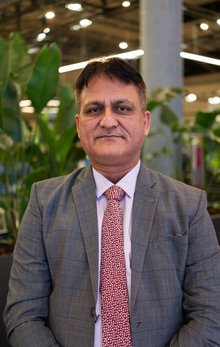
Dr Muhammad Kashif Shahzad
Chief Executive Officer