
Scope 3, Solar & Sourcing: Tesco's Sustainability Report
Tesco’s 2026 Sustainability Report sets out how the retailer is advancing its transition to a lower-carbon, energy-efficient business while building a more resilient food system and keeping costs accessible for customers.
The report details progress across emissions reduction, renewable energy adoption, energy efficiency and food waste, alongside its efforts to promote healthier diets throughout its operations and supply chains.
It also highlights how Tesco is working closely with suppliers, farmers, charities and industry partners to accelerate decarbonisation and deliver on its long-term net zero ambitions.
Accelerating renewable energy and efficiency
Energy strategy is a central pillar of Tesco’s decarbonisation roadmap, with major gains delivered through efficiency improvements and renewable electricity sourcing.
The company surpassed its December 2025 target by reducing Scope 1 and 2 emissions by 68% against a 2015/16 baseline, exceeding its original 60% goal.
Renewable electricity now accounts for 100% of Tesco’s power use across the Group, secured through renewable energy certificates, Power Purchase Agreements (PPAs) and on-site generation.

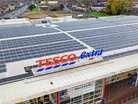
In 2025/26, solar installations were expanded with rooftop panels added to 29 UK stores, while the Aylesford distribution centre now hosts the largest solar array in Tesco’s estate.
Alongside generation, Tesco continues to invest in energy-saving technologies, including fridge doors that use around one-third less energy than open-fronted units, electric heat pumps replacing gas boilers and a centralised Energy Control Centre that monitors performance across its property portfolio.
The retailer is targeting net zero across its full value chain by 2050, with its own operations set to reach net zero by 2035.
“As Chair of the Sustainability Committee, I have seen first-hand the determination across Tesco to embed sustainability into every part of the business,” says Stewart Gilliland, Chair of the Sustainability Committee and Non-Executive Director at Tesco, in the company’s 2026 Sustainability Report.
“The store demonstrates how practical solutions can help us decarbonise retail and inspire change across the industry," he adds.
“Alongside this, we have supported progress on healthier baskets, nature‑based solutions and waste reduction, while continuing to champion human rights and community programmes such as Fruit & Veg for Schools.”
Tesco's priorities on the road to sustainability
Tesco's 'Planet Plan' is the company's strategy for achieving sustainability across its operations. All in, it contains six key priorities, many of which are energy-focused. These are:
- Cutting store emissions
- Decarbonising transport
- Protecting nature
- Eliminating waste
- Improving products
- Enabling sustainable consumption.
Recognising that food production accounts for around one-third of global greenhouse gas emissions, Tesco is addressing climate risks such as drought, flooding and biodiversity loss that increasingly threaten supply stability.
Its approach includes working with suppliers to promote sustainable agriculture, reduce deforestation, improve soil health and scale nature-based solutions.
The retailer is also expanding landscape restoration initiatives and introducing financial incentives to support farmers adopting lower-carbon practices.
“As food systems come under increasing pressure, sustainability is key to our long-term resilience,” says Christine Heffernan, Group Chief Communications and Sustainability Officer at Tesco.
“Our actions today help meet customer needs and strengthen supply chain stability for the future.”
Integrating energy strategy across the supply chain
Tesco’s report makes clear that supply chain decarbonisation remains the most significant challenge, with nearly 99% of its carbon footprint originating beyond its direct operations as Scope 3 emissions.
This places energy use, agricultural practices and product lifecycles at the centre of its climate strategy.
Through Sustainable Farming Groups, Tesco is working with suppliers to implement lower-carbon techniques, precision agriculture and regenerative practices that improve both efficiency and biodiversity.
The retailer has also introduced data-sharing programmes to improve emissions tracking and support the adoption of science-based targets across its supplier network.
In manufacturing and logistics, Tesco is collaborating with key partners to develop joint decarbonisation plans and share best practice through site visits and knowledge exchange.
Transport remains another focus area, with continued investment in electric delivery vans, Bio-CNG trucks, expanded rail freight and route optimisation initiatives designed to cut fuel consumption and reduce road miles.
Company portals
Executives

Christine Heffernan
Group Chief Communications and Sustainability Officer

Stewart Gilliland
Chair of the Sustainability Committee and Non-executive Director