
Ansarada: Clunky Procurement is Curbing the Renewables Boom
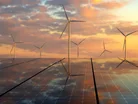
In 2025, global investments in renewable energy infrastructure were just shy of half a trillion dollars.
That eye-watering amount of capital is roughly equivalent to the GDP of modern economies like Denmark or Singapore.
According to new research from infrastructure procurement platform Ansarada, investments in renewables last year shot up 49% from 2024, hitting US$496.7bn worldwide.
Ansarada’s breakdown of the stats yields yet more insights. Europe is currently leading the charge, commanding US$202.7bn across 1,035 transactions, which represents an 82% increase in value on the previous year.
Of the energy sources, offshore wind was the standout performer. The study shows that the value of offshore wind investments surged 290% to US$89.8bn.
This was headlined by the financial close of the 1.4GW East Anglia Three project off the UK's east coast, which secured a £3.6bn (US$4.8bn) debt package backed by 24 international lenders.
With the renewable energy market seemingly in such rude health, the outlook for the years up until 2050 seems to be rosy. Beneath the surface, however, Ansarada has found some troubling cracks.
The execution problem
Despite the overall value of investments skyrocketing, the study finds that the actual volume of transactions rose just 7% globally, and only 4% in Europe.
The gap tells its own story: capital is concentrating into fewer, larger and more complex projects.
These are the kinds of initiatives that demand rigorous, auditable procurement processes to get off the ground.
To dig deeper into the experiences of industry leaders, Ansarada interviewed 150 executives about their perception of procurement in the energy sector.
The subsequent statistics are telling. Just 37% of those surveyed across EMEA and the Americas described their most recent renewables procurement process as "very efficient".
In Asia-Pacific, that figure drops to just 24%.
Justin Smith, who is MD at Ansarada, is quite direct about what this means.
"Europe has established itself as the global benchmark for renewable energy infrastructure, with regulatory frameworks and supply chains that attract institutional capital at scale," he says.
"But there's a critical disconnect between the ambition reflected in investment figures and the procurement processes actually delivering projects. Capital is abundant, but execution capability is the binding constraint."
A transparency deficit with real consequences
The problem is not only one of efficiency.
Ansarada’s report finds that around 90% of EMEA respondents described transparency and auditability as "very important" or "essential" to their procurement processes, yet nearly a third admitted those same processes lacked clarity for internal stakeholders.
This is a difficult state of affairs to navigate, especially at a time when sustainability mandates and ESG regulations are becoming more and more stringent across the EU.
“The transparency gap isn't just an operational inefficiency; it's a commercial risk,” says Justin.
“Institutional investors and project financiers increasingly demand auditable evidence that ESG criteria are genuinely embedded in procurement.
“Organisations that can't demonstrate that risk losing access to the capital that large-scale renewable projects need.”

The Frankenstack problem
So why are procurement processes falling short at the moment? Part of the answer lies in what Ansarada calls “fragmentation” – the kind of unjoined thinking that leads to data siloing, slow tender processes and hiccups in communication.
While 91% of respondents claimed to use purpose-built procurement software, EMEA organisations were found to be running an average of 3.8 disconnected systems simultaneously.
Perhaps more alarmingly, 55% of respondents say they still rely on email to manage correspondence when it comes to sensitive bidding.
Andy Potter is the Business Development Director in EMEA at Ansarada. He believes that these approaches could be vastly improved.
“If you're still using fragmented systems or traditional cloud storage, you lose that 'golden thread' of accountability that modern regulators and investors now demand,” he says.
Meanwhile, Justin describes the result as a "Frankenstack" – a patchwork of incompatible tools that creates the illusion of digitalisation without delivering its substance.
The road ahead
What seems clear from Ansarada’s report is that the procurement issues in renewable energy will have to be ironed out in order to meet skyrocketing demand.
Analysis from Bain & Co. cited in the report suggests global compute requirements alone could reach 200GW by 2030, driven by AI infrastructure.
This, in short, will make reliable green energy an industrial necessity rather than a nice-to-have climate ambition.
The conflict in the Middle East and the negative impacts it is having on the global hydrocarbons market only emphasise this further.
Energy sector insiders understand this. Speaking about the war’s impact on the UK’s energy landscape, Christophe Williams, CEO of Naked Energy, says: “Tackling heat with British and European made clean technologies is one of the fastest ways to lower exposure to gas prices while strengthening energy security.”
But ambition and delivery are two very different things.
As Justin puts it: “The question for Europe is whether procurement processes can match the scale of ambition reflected in investment figures.
“Capital is flowing toward large-scale and integrated projects, but delivery depends on treating procurement as critical project infrastructure from day one, not an administrative afterthought.”
Company portals


Executives

Andy Potter
Business Development Director in EMEA

Christophe Williams
CEO

Justin Smith
Managing Director