How IBM & NASA's AI Solar Predictions can Support Grids
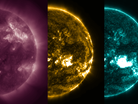
The phenomena of solar flares and coronal mass ejections carry the potential to crash satellites, disrupt aviation systems and even lead to widespread power outages.
IBM and NASA have joined forces to develop an open-source AI foundation model designed to decode high-resolution solar observation data and predict how solar activity affects technologies.
Named Surya, this tool aims to protect technologies from GPS navigation to power grids.
"Think of this as a weather forecast for space," explains Juan Bernabe-Moreno, Director of IBM Research Europe, UK and Ireland.
"Just as we work to prepare for hazardous weather events, we need to do the same for solar storms.
“Surya gives us unprecedented capability to anticipate what's coming and is not just a technological achievement, but a critical step toward protecting our technological civilisation from the star that sustains us."
The Sun’s impact on Earth
Despite being 93 million miles apart from Earth, the Sun’s flares and coronal mass ejections can affect numerous technologies in daily use.
According to a systemic risk scenario created by Lloyd's, the global economy could be exposed to losses of US$2.4tn over a five year period, with the expected loss of US$17bn from the threat of a hypothetical solar storm.
A solar flare is a sudden, intense burst of electromagnetic radiation from the Sun’s atmosphere, typically triggered by the rapid release of magnetic energy near sunspots.

Intense X-rays and ultraviolet radiation from flares can ionise the Earth's upper atmosphere, leading to radio communication blackouts and, occasionally, radiation storms affecting satellites and astronauts.
Larger flares are sometimes associated with coronal mass ejections, large expulsions of plasma from the Sun’s outer atmosphere, which can trigger geomagnetic storms on Earth.
Both solar flares and coronal mass ejections pose severe threats by disrupting Earth-based and orbital technologies, damaging satellites with energetic particles and radiation or impacting power grids during geomagnetic storms.
Justina Nixon-Saintil, Vice President and Global Chief Impact Officer at IBM, said on LinkedIn: “Surya is part of the Prithvi family of models, which also includes geospatial and weather models, both of which we use in our IBM Impact Accelerator projects, supporting solutions in community resilience, agriculture and water management.
“These technologies depend on satellites, and those satellites depend on stable conditions in space.”
“Surya reflects our deep belief in open innovation and shared progress.
“As environmental challenges grow more complex, we need tools that are accessible and grounded in science.
“By anticipating the impact of solar activity, we help protect critical systems and build more resilient futures.”
How can Surya help?
Traditional solar weather prediction has been reliant on fragmented satellite views of the Sun’s surface, complicating accurate forecasts.
NASA and IBM’s model is trained on an expansive curated high-resolution heliophysics dataset, aiding researchers in analysing and evaluating space weather prediction tasks.
Examples of Surya’s capabilities include forecasting solar flares, measuring solar wind speeds, predicting solar EUV spectra and identifying active regions on the Sun.
IBM says that early testing has found a 16% improvement in solar flare classification accuracy and the ability to visually predict solar flares up to two hours ahead of them occurring.
The model was trained on nine years' worth of high-resolution solar observation data from NASA's Solar Dynamics Observatory, with image sizes ten times larger than typical AI training datasets.
A customised multi-architecture solution was adopted to manage this extensive scale while preserving efficiency.
"We are advancing data-driven science by embedding NASA's deep scientific expertise into cutting-edge AI models," says Kevin Murphy, Chief Science Data Officer at NASA Headquarters in Washington.
"By developing a foundation model trained on NASA's heliophysics data, we're making it easier to analyse the complexities of the Sun's behavior with unprecedented speed and precision.
“This model empowers broader understanding of how solar activity impacts critical systems and technologies that we all rely on here on Earth."
IBM and NASA have released Surya on Hugging Face to democratise access to advanced tools and allow researchers to build on this foundation.