
How Wind and Waves Power China's Underwater Data Centres
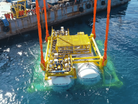
China has initiated operations at the world’s first commercial underwater data centre, a development that merges renewable energy with digital infrastructure.
The project, situated in Lingshui County, Hainan Province, represents a step forward in the nation's strategy to grow its marine-based economy, using wind power and ocean cooling.
The facility consists of a 1,300-tonne underwater data cabin submerged 35 metres beneath the sea. Each of these cabins is engineered to house 24 server racks, with a capacity for 400 to 500 servers, which are tasked with processing a range of digital services.
Subsea design and cooling efficiency
The decision to place digital hardware on the seabed is a matter of operational efficiency. Project Manager Pu Ding, from Shenzhen HiCloud Data Centre Technology, explained that the primary benefit is using the natural cooling properties of the ocean.
“We put the entire data cabin in the deep sea because seawater can help cool down the temperature," Pu says.
He adds: "Compared to land-based data centres, data centres under the sea can reduce energy consumption needed for cooling, helping to lower operational costs.”
This approach is central to Hainan’s 14th Five-Year Plan, which outlines the deployment of up to 100 such underwater data cabins.
These will form part of a larger industrial estate focused on new marine economy technologies. Following this, a second underwater data centre is complete in the Lin-gang Special Area of Shanghai’s Pilot Free Trade Zone.
Trailed as the first wind-powered underwater data centre globally, the US$226m Shanghai project sources 95% of its electricity from nearby offshore wind farms.
The system is designed to lower total power consumption by 22.8%, use no fresh water and reduce land occupation by more than 90%.
In its initial phase, the facility has recorded a Power Usage Effectiveness (PUE) of no higher than 1.15, which is below China's national target of 1.25 for large data centres by 2025.
Strategic response to global data demand
The growth of cloud computing and generative AI is increasing demand for high-performance data infrastructure worldwide.
In response, China's pilot programme permits foreign ownership of data centres and related telecoms services in key areas including Hainan, Shanghai, Beijing and Shenzhen, a move that could attract multinational technology firms.
The Lin-gang project is specifically built to manage AI workloads, 5G infrastructure, industrial Internet of Things (IoT) applications and e-commerce systems.
China's current efforts appear to be learning from earlier international experiments. In 2014, Microsoft initiated Project Natick, which involved submerging an 855-server prototype off the coast of Scotland in 2018.
After a two-year testing period, Microsoft concluded the project in 2024 without pursuing commercialisation. In contrast, China is moving directly from demonstration to full-scale operations.

The Lin-gang project has a current capacity of 2.3 megawatts, with a second phase planned to increase this to 24 megawatts.
Environmental performance and future challenges
The facility is powered almost entirely by offshore wind, tapping into one of the country's most abundant renewable energy sources.
According to Huang Dinan, President of Shenergy Group, a key contractor on the project, the East China Sea offers over 3,000 hours of annual wind utilisation – making it an ideal location for hybrid wind–digital infrastructure.
The design avoids the need for land-based cooling towers and air conditioning, reducing its environmental footprint and freeing up valuable coastal land in dense urban areas.
The Lin-gang underwater data centre supports Shanghai’s goal of becoming a global technology innovation hub and aligns with national strategies like the ‘East Data, West Computing’ megaproject.
This initiative seeks to build data centres in western provinces to process data from the more developed eastern regions.
However, the long-term viability of this technology hinges on addressing several key challenges, including:
- Maintenance and reliability to ensure subsea servers can be repaired and upgraded efficiently.
- Marine ecosystem management to study and mitigate any impact on local biodiversity.
- Cost and scalability to drive down expenses and make underwater data centres commercially competitive against traditional facilities.