
How will Mitsui’s Port Purchase Boost North Sea Renewables?
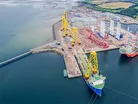
Mitsui & Co., Ltd has signed an agreement through Mitsui & Co. Europe Ltd. to acquire the Port of Nigg in northeast Scotland and part of the business owned by GEG (Holdings) Limited ("GEG"), jointly with Mitsui O.S.K. Lines, Ltd (MOL).
The acquisition spans steel processing and equipment manufacturing alongside base port operations serving the energy sector, with a primary focus on offshore wind and ongoing roles in oil and gas.
Upon closing, the assets are set to be operated by Global Energy Service Holding Limited (GESH), headquartered in Inverness, Scotland, with Mitsui holding 51% and MOL 49%.
In parallel, Mitsui will sell its equity in GEG’s remaining businesses back to the company’s founder.
The Port of Nigg’s position on Scotland’s North Sea coast, within the world’s largest offshore wind development area, makes it a strategic platform for staging, assembling and servicing large-scale projects.
By pairing Mitsui’s global industrial networks and investment track record in the UK, including prior work with STATS (UK) Ltd., with MOL’s maritime and port operations expertise, the partners aim to strengthen manufacturing capacity, modernise port services and integrate supply chains that accelerate renewable deployment.

Sustainability and energy transition impact
The UK’s twin goals of bolstering energy security and reaching net zero by 2050 depend on expanding reliable, efficient infrastructure for renewables.
Scaling the Port of Nigg’s port and fabrication capabilities is expected to ease bottlenecks that slow offshore wind projects, enabling clean generation to come online faster and displace higher-emission sources.
Localised heavy fabrication and assembly can shorten transport routes and reduce logistics emissions, while integrated port operations can improve throughput and reliability across the offshore wind value chain.
As the platform develops, there is scope to pursue operational decarbonisation, including greater use of renewable electricity, electrification of handling equipment, optimised vessel calls and routing and, where appropriate, shore power to curb at-berth emissions.
“While efforts towards decarbonisation seems to be slowing down currently, i believe the initiatives themselves are irreversible, which seems to be the consensus,” says Tetsuya Shigeta, Representative Director, Executive Vice President, CFO.
“If wind power generation slows down, we believe business viability can be secured by providing services for other businesses.”
Material efficiency, design optimisation and increased recycled content in steel processing can further lower embodied carbon in components.
These measures align with Mitsui’s material issues by helping to establish a foundation for sustainable and stable energy supply and by supporting a community that coexists with nature through responsible development and marine stewardship.
Transparent environmental management, biodiversity protection and ongoing monitoring will be essential to maintain community trust and minimise impacts as activity grows.
Local value, governance and timeline
The transaction creates a dedicated operating platform in GESH, which launched on 7 February 2024, is represented by Yoshihiro Hayakawa and employs 248 people.
Focused governance and clear ownership are expected to support investment, safety and performance improvements as the Port of Nigg evolves into a leading North Sea hub.
The development can catalyse high-quality, future-facing jobs in the Highlands and provide transition pathways for workers moving from oil and gas into offshore wind and advanced manufacturing.
Partnerships with colleges and training providers can expand the skills pipeline, while collaboration with local authorities and grid operators will be important to align transport and transmission upgrades with project growth.
Following completion in summer 2025, the partners plan to integrate port operations and manufacturing to deliver reliable, lower-carbon services to offshore wind developers.
Progress can be demonstrated through tangible outcomes, such as increased offshore wind capacity supported through the port, improved on-time and on-budget project delivery, reductions in Scope 1 and 2 emissions from port and fabrication activities and broader social indicators, including local employment, training and safety performance.
By uniting Mitsui’s industrial reach with MOL’s maritime strengths, the acquisition is designed to reinforce the UK’s energy resilience, advance net zero goals and deliver durable community benefits rooted in a competitive, low-carbon supply chain.