Inside Mercedes' Plan to Decarbonise its F1 Operations
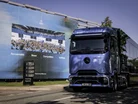
The Mercedes-AMG PETRONAS F1 Team is expanding its use of the all-electric Mercedes-Benz Trucks eActros 600 across nine European races in the current Formula 1 season.
The vehicle will operate alongside HVO100-fuelled race and marketing trucks, supporting the transportation of critical race infrastructure while shifting the team’s logistics energy mix away from fossil fuels.

Electrifying motorsport logistics
The eActros 600 is expected to travel around 15,000km during the European leg of the championship, which runs through to Madrid in September.
Building on its earlier deployment in 2025, including a pilot at the British Grand Prix, Mercedes is increasing reliance on electric-powered transport across longer distances.
In a first for the sport last season, Mercedes transported its W16 race cars from Brackley in Northamptonshire to Zandvoort using fully electric haulage, demonstrating the viability of battery-powered logistics at scale.
By rolling out the eActros 600 across all nine European races, the team is signalling growing confidence in the performance and reliability of long-distance electric freight.
“We are realising our ambition of deploying the Mercedes-Benz Trucks eActros 600 across all nine European races, demonstrating our commitment to accelerating decarbonisation in some of the hardest-to-abate areas of our operations,” says Alice Ashpitel, Head of Sustainability for the Mercedes-AMG PETRONAS F1 Team.
“As a team, we are committed to engineering change on and off the track and it’s exciting to see how quickly we have moved from pilot journeys to a full rollout.”
Energy transition in freight operations
The Mercedes-Benz Trucks eActros 600 recently completed a 1,600km journey from Brackley to Monaco, transporting essential trackside infrastructure including communications units and medical facilities.
For a global racing team, freight movement represents a major source of energy demand and emissions. Electrification offers a pathway to reduce reliance on diesel while improving overall energy efficiency across logistics operations.
Expanding the use of electric trucks strengthens Mercedes’ portfolio of lower-emission transport solutions and supports progress on Scope 3 emissions, which are largely driven by supply chain and logistics activities.
The initiative forms part of a broader strategy to decarbonise logistics energy use, which also includes the widespread adoption of HVO100 biofuel, delivered in partnership with PETRONAS.
"We are proud to be pushing the boundaries of what’s possible in Formula One logistics once again,” says Ash Armstrong, eConsultancy Manager at Daimler Truck UK.
“With the eActros 600 supporting the Mercedes-AMG PETRONAS F1 Team at all nine European races this season, this project is a powerful demonstration that long-haul electric transport is not a future ambition, it's a reality today.
“Building on the success of last year’s programme, this collaboration showcases both the capabilities of the eActros 600 and the rapid evolution of Europe’s charging infrastructure.
“It’s further evidence of how Mercedes-Benz Trucks is helping to redefine sustainable transport, not only in the demanding world of Formula One, but across the logistics industry as a whole."
In 2025, the team achieved 99% coverage of HVO100 fuel across its European race and marketing fleet, avoiding more than 410 tonnes of CO₂-equivalent emissions.
Embedding energy strategy across the supply chain
The Mercedes-AMG PETRONAS F1 Team is extending its focus beyond direct operations to address energy use and emissions across its wider supply chain.
Through a combination of emissions reduction measures and investment in carbon removal projects, the team is targeting residual emissions while prioritising improvements in high-energy activities such as transport and operations.
A major priority is Scope 3 emissions, which typically account for the largest share of total carbon output and are closely linked to supplier energy use.
To address this, Mercedes is engaging suppliers through sustainability-focused events, enhanced standards within its Supplier Code of Conduct and the use of risk screening tools to assess environmental impact.
Alongside low-carbon fuels and electrified logistics, this coordinated approach demonstrates how energy strategy and supply chain management can align to deliver measurable reductions in emissions while supporting long-term climate targets.
Company portals


Executives
Alice Ashpitel
Head of Sustainability

Ash Armstrong
eConsultancy Manager