
Lenovo Neptune: Can Data Centre Cooling use Warm Water?
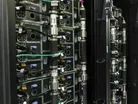
Operators of data centres are turning to liquid cooling technologies as they look to manage the thermal and energy challenges posed by modern AI infrastructure.
Lenovo's Neptune liquid cooling platform has been rolled out across its entire data centre range, marking a change in how high-density computing environments could be managed.
Neptune’s design focuses on reducing total facility power use at a time when traditional air cooling is no longer capable of supporting the heat output of dense AI and HPC systems.
Lenovo reports that servers running on Neptune operate with up to 40% lower power than comparable air cooled systems, providing a route to stable performance without increased cooling overheads.

Addressing AI's thermal challenge
The rise of AI workloads has generated a fundamental shift in heat output, bringing air-based cooling systems to the edge of their operational capacity.
According to the International Data Corporation (IDC) & Lenovo CIO Playbook 2025, sustainability has emerged as a key priority for technology leaders, with the energy cost of cooling forming a critical component of that agenda.
Neptune Direct Water Cooling works by circulating warm water directly to processors and memory modules, extracting heat at the point of generation.
Traditional chilled water systems typically require coolant temperatures of around 18°C, but Neptune operates with water temperatures reaching approximately 45°C.
This removes the need for chillers, reduces reliance on air handling infrastructure and improves efficiency in high-density rack configurations.
Lenovo reports that servers running Neptune technology use up to 40% less power than equivalent air-cooled systems, offering a pathway to consistent performance without the burden of escalating cooling costs.
The sixth iteration of Neptune draws on more than 10 years of development and hundreds of patents.
A newly introduced vertical liquid-cooled chassis has been designed to accommodate accelerated computing within a reduced physical footprint.
The system is entirely liquid-cooled, eliminating internal fans and cutting energy consumption across the facility.
Neptune and net zero targets
Neptune plays a central role in Lenovo's ambition to reach net zero carbon emissions by 2050, a commitment validated by the Science Based Targets initiative.
By lowering cooling demands and supporting warm water loops that can be integrated into existing infrastructure, the technology aligns with long-term objectives around emissions reduction and energy performance.
Demand for energy-efficient solutions is growing rapidly across Asia Pacific, where electricity consumption linked to AI, cloud computing and digital services continues to climb.
Lenovo forecasts that regional data centre consumption could increase from 320 TWh in 2024 to 780 TWh by 2030.
In this context, energy efficiency is becoming inseparable from commercial sustainability.
Kumar Mitra, Executive Director for Lenovo Infrastructure Solutions Group in Central Asia Pacific and Australia & New Zealand, says: “Across Asia Pacific, organisations are looking for AI infrastructure that is not only powerful but also fundamentally more energy efficient. Neptune gives our customers that advantage.
"As AI scales, solutions that combine performance with responsible energy use will define the next era of digital growth, and that is exactly what Lenovo is delivering.”
Deployment data and efficiency metrics
The Neptune ecosystem integrates Direct to Node warm water cooling, Rear Door Heat Exchangers and Thermal Transfer Modules within a closed loop architecture.
Warm coolant passes through cold plates attached to critical components and returns between 10°C and 15°C warmer before transferring heat into a separate facility loop.
The process eliminates the need for chilled water and maintains stable performance even at elevated rack densities.
Lenovo's ThinkSystem SR780a, equipped with Neptune cooling, has achieved a Power Usage Effectiveness of 1.1. PUE measures the ratio of total facility power to IT power, and a reading of 1.1 indicates that just 0.1 watts are consumed for cooling per watt of computing.
Neptune-powered platforms are already deployed in some of the most demanding operational environments.
DreamWorks Animation recorded a 20% performance improvement alongside reduced cooling requirements after adopting Neptune-cooled high-performance computing (HPC) systems.
The technology is also in use at meteorological agencies in Korea and Malaysia, as well as universities, research centres and digital content studios throughout Asia Pacific.
Company portals

Executives
Kumar Mitra
GM & MD
