Rooftop Revolution: The UK Government's Roadmap for Solar
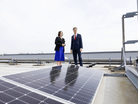
While the UK may not be known for its sunshine, its potential for solar energy is substantial, offering a way to mitigate environmental footprints and boost energy independence.
The UK has 18 GW of installed solar capacity, and the government aims to increase this to between 45 to 47 GW by 2030.
To support this ambition, the UK Solar Taskforce was set up and it has now published the UK Solar Roadmap.
The plan outlines that only about 0.4% of the UK's land would be necessary for ground-mounted solar setups, with a substantial opportunity existing for rooftop installations as well.
Chris Stark, Head of UK’s Mission for Clean Power at the UK Department for Energy Security and Net Zero, says: “Solar generation is the best example of a clean technology that can bring substantial bill savings and energy system benefits at multiple scales, from household rooftops to efficient, well-sited installations on the scale of whole power stations.

“The Clean Power Action Plan seeks 45-47GW of installed solar capacity by 2030, a once-in-a-generation increase.
“This will only be possible with a mission-focus, industry and government working in partnership to grow solar at pace and fundamental reforms to the queue of projects waiting to connect to the grid.”
A variety of companies supported the development of this roadmap, including:
- EDF Renewables
- Lightsource bp
- Mitie
- National Grid
- Octopus Energy
- SSE Renewables
Key solar objectives in the UK
Beyond the goal of reaching 45-47 GW of installed solar capacity by 2030, the roadmap says that this could expand to reach 54-57 GW if system needs and rooftop solar deployment allow.
The solar sector is expected to support around 35,000 jobs by 2030, doubling current employment.
Expanding solar energy in the UK will reduce the country’s reliance on volatile fossil fuel markets.
This, therefore, could lower energy bills and support the UK’s energy independence.
Rooftop solar
With solar already installed on more than 1.5 million homes, the roadmap aims to expand this number.
“We will push ahead on a solar rooftop revolution, while tackling the barriers of planning, grid, supply chains and skills,” says Ed Miliband, Secretary of State for Energy Security and Net Zero and Co-Chair of the UK Solar Taskforce.
“Publishing this roadmap is just the beginning of our journey – and we will establish a joint Government and industry Solar Council to drive progress towards our ambitions.”
The taskforce estimates that installing rooftop solar could save the typical UK household about £500 (US$685) annually.
Removing historical barriers, the government has eliminated the mandate requiring planning permission for installations exceeding 1 MW.
For both new and existing homes, initiatives such as the Warm Home Plans and Future Homes Standard could reduce initial installation costs.
Electricity networks
Renewable energy projects' proliferation has led to a spike in grid connection requests at both transmission and distribution levels.
This surge has crowded the queue, affecting project timelines.

“The Government is therefore committed to a fundamental and urgent reform of the connections process, as set out in the Clean Power Action Plan,” the report reads.
To align grid connections with the 2030 goals, the plan introduces solar specific capacity allocations
Additionally, Ofgem is reviewing the entire connection process to enhance efficiency and service across all scales, including domestic solar panels.
Chris Hewett, CEO of Solar Energy UK, says: “Solar energy is among the lowest cost, and most popular forms of power generation in the UK and unlocking its potential will increase Britain’s energy security, drive down bills as well as be a major contributor to preventing dangerous climate change.
“The fact that it can be deployed rapidly in so many ways from household rooftops, to warehouses, to reservoirs and large-scale solar farms, is the key ingredient to this potential.”
Solar supply chain dynamics
Solar supply chains can be complex and global, with polysilicon needed for the manufacturing of solar panels.
The report says that the government is determined to “eradicate the abhorrent practice of modern slavery and its commitment to ensuring that supply chains are free from the use of forced labour, including on members of Uyghur and other minorities in Xinjiang involved in the mining of polysilicon used in the manufacture of solar panels”.
Measures are set to be added to the Great British Energy Bill to ensure slavery and human trafficking do not take place in its business or supply chains.
The government also aims to empower contracting authorities to exclude suppliers from government contracts who have committed labour market misconduct or environmental offences.
“While the UK is unlikely to be able to compete in the existing global market for conventional solar panels, there is scope to grow industries producing balance of system components,” the report says.
Explore the latest edition of Energy Digital Magazine and be part of the conversation at our global conference series, Sustainability LIVE.
Discover all our upcoming events and secure your tickets today.
Energy Digital is a BizClik brand