
The UN SDGs Report 2026: Energy and Climate Pressure Mount
The United Nations (UN) has published its Sustainable Development Goals (SDGs) Report 2026, underscoring that the world is now just four years away from the 2030 deadline.
The report shows that progress is increasingly tied to resilient energy systems, procurement, manufacturing capacity, supply chain stability and digital infrastructure.
While advances continue across several goals, only 36% of the 139 measurable targets are on track or making moderate progress, 49% are moving “too slowly” and 15% have worsened since 2015.
The UN attributes these setbacks to climate change, slower economic growth, higher debt, conflict and weakening development assistance.

The energy transition and industrial resilience
Energy remains central to sustainable industrial growth and the report presents both progress and exposure. Since 2015, electricity access has risen to 92% of the global population, while around one-third of global electricity is now generated from renewable sources.
Internet access has also climbed from 40% to 74%, opening up more scope for connected manufacturing, digital procurement and efficiency gains across industrial operations.
Yet the energy picture is far from stable. The report says conflict, trade disruption and climate-related stress are feeding through to prices, logistics and production, with energy availability increasingly linked to wider economic resilience.
In 2024, 673 million people experienced chronic hunger and 2.3 billion faced moderate or severe food insecurity.
- Global temperatures reached 1.43°C above pre-industrial levels in 2025, bringing the world closer to the 1.5°C threshold
The report states that the war in the Middle East has “disrupted maritime traffic, choking off energy, fertiliser and food corridors and driving up inflation.”
Disruptions around the Strait of Hormuz have affected shipments of fertilisers, sulphur, natural gas and fuels, increasing production and transport costs across global manufacturing and food supply chains, particularly for economies reliant on imports.
“With just four years until the SDGs target date, the gap between ambition and achievement has never been more stark – or more consequential,” writes Li Junhua, Under-Secretary-General for Economic and Social Affairs, United Nations, in the report.
“The SDGs remain our most effective blueprint for peace, prosperity and sustainability. We must urgently return them to the centre of global decision-making.”
Procurement and investment
Investment in sustainable agriculture and production continues to rise, though the gains remain uneven across regions.
Global public spending on agriculture reached a record US$725bn in 2024, increasing by an average of 2% each year since 2015, while agricultural aid to developing countries reached US$18.7bn, up 42% over the same period.
- Approximately 2.1 billion people (one in four globally) still lack safely managed drinking water services
In 2024, Africa received US$8.7bn in agricultural support, nearly double its 2015 level.
Even so, productive and sustainable agriculture scored just 3.3 out of 5, indicating that progress is still short of the 2030 target. Productivity, employment conditions and unequal access to technology, investment and markets continue to constrain sustainable manufacturing and agricultural supply chains.
Meanwhile, the share of countries facing moderately to abnormally high food prices dropped from 51.2% in 2023 to 15.3% in 2024, helped by lower fertiliser costs and better agricultural output.
“The direction we choose now will determine whether the progress of the past decade holds or unravels,” says António Guterres, Secretary-General, United Nations.
AI and sustainability data
The report casts artificial intelligence as both a tool and a governance challenge for sustainability. AI is already being used for questionnaire design, data collection, quality assurance and analysis, with a review of about 1,800 studies showing applications across the full survey lifecycle.
The global SDG database has also expanded from about 330,000 records in 2016 to 3.2 million in 2026, giving organisations a stronger evidence base for sustainability reporting, energy planning and wider decision-making.
- In 2024, 683 million more people experienced food insecurity compared to 2015
However, official development assistance fell by 23.1% in 2025, the largest annual decline on record, reducing support for national statistical systems just as demand for reliable data continues to rise.
The report says governments, businesses and technology providers must ensure AI is used transparently and responsibly while continuing to invest in digital infrastructure, trusted data systems and international collaboration to support procurement, manufacturing, energy planning and long-term sustainable development.
Healthcare under strain
Healthcare outcomes have improved markedly over the past decade, though progress remains uneven and is increasingly exposed to funding pressures.
Since 2015, new HIV infections and AIDS-related deaths have each fallen by more than 30%, tuberculosis deaths are declining after a pandemic-related rise and 780 million fewer people now require treatment for neglected tropical diseases.
- It is reported that 59 countries have eliminated at least one neglected tropical disease
Maternal mortality has fallen from 228 deaths per 100,000 live births in 2015 to 197 in 2023, while births attended by a skilled health professional rose from 80% to 87% between 2015 and 2025.
Despite that progress, around 260,000 women died from pregnancy-related causes in 2023, with maternal mortality still more than two and a half times above the SDG target and fragile, conflict-affected countries accounting for 61% of global maternal deaths.
The report warns that official development assistance for health has returned to 2015 levels, with further declines expected, putting health systems, disease prevention programmes and vulnerable populations at greater risk unless investment in primary care, immunisation and international cooperation is strengthened.
Company portals
Executives
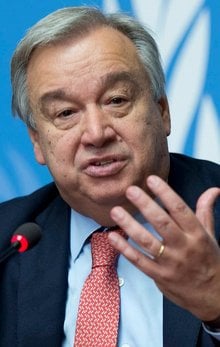
António Guterres
Secretary General