
What Qcells' First US Plant Says About Trump's View on Solar
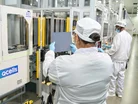
South Korea's Hanwha is one of the world's largest and most diversified manufacturing companies.
Having made its name in the 1950s as an explosives manufacturer, the intervening years have seen the Seoul-based firm enter into all manner of sectors, from aerospace and shipbuilding to machinery and energy.
Energy – specifically clean energy – is now one of Hanwha's biggest focuses.
Its subsidiary Qcells is a globally renowned manufacturer of solar panels, with its products ranked as the most popular solar panels in the US by Wood Mackenzie.
Until now, though, the company has never had a base of operation in the US, instead shipping its goods across the Pacific from the Korean Peninsula.
The firm's newly opened production plant in Cartersville, Georgia, is its first physical footprint in America.
The wider energy context gives the announcement added significance.
Energy thinktank Ember reported on 10 June 2026 that solar had surpassed coal in US power generation in May, marking the first time the technology had done so in a monthly reading.
Solar accounted for a record 12.8% of US electricity output in May 2026, while coal slipped to 12.2% – its fourth-lowest monthly share on record – despite the Trump administration's active promotion of fossil fuel energy sources.

Qcells' Cartersville plant
Qcells, the solar manufacturer owned by South Korean conglomerate Hanwha since 2012, says the start of solar cell production at its Cartersville, Georgia facility marks a major step towards completing what it describes as the only vertically integrated solar manufacturing plant in the country.
Hanwha is targeting rapid scale-up. By Q3 2026, the Cartersville site is expected to produce 3.3GW each of ingots, wafers and cells annually, alongside 3.5GW of modules – figures that would make it the largest solar cell factory in US history.
Module assembly at the site is already running at full capacity, with 16,700 panels produced each day.
"Producing the first solar cells at Cartersville is a milestone for Qcells and for American manufacturing," says Andy Park, Global CEO of Qcells.
"As our ingot, wafer and cell lines reach full capacity, we'll be making the major components of a solar panel right here in Georgia," he adds.
"A dependable domestic supply chain doesn't just create thousands of good-paying jobs, it gives our customers greater certainty on price, supply and tariffs, and a product they can trust from start to finish."
Georgia operations and energy output
Qcells has maintained a manufacturing presence in Georgia since 2019, when it opened its site in Dalton. That campus tripled its module capacity to 5.1GW in late 2023.
Combined with Cartersville, total module capacity across Qcells' Georgia operations is expected to reach 8.6GW a year – equivalent to 47,000 panels per day, or sufficient energy to power approximately 1.3 million US homes annually.
The two sites are expected to support nearly 4,000 jobs, with an estimated 3,800 direct roles.
Tax credits and supply chain resilience
The energy policy environment adds further complexity to the company's position.
President Trump has been openly critical of solar power and has moved to dismantle clean energy tax credits.
An executive order from his administration, titled 'Ending Market Distorting Subsidies for Unreliable, Foreign Controlled Energy Sources', stated: "For too long, the Federal Government has forced American taxpayers to subsidise expensive and unreliable energy sources like wind and solar.
"Moreover, reliance on so-called 'green' subsidies threatens national security by making the United States dependent on supply chains controlled by foreign adversaries."
Qcells, however, appears to have avoided the worst of those reforms.
Its fully domestic manufacturing footprint qualifies the company to claim the Section 45X Advanced Manufacturing Production Tax Credit at every stage of production, from ingots and wafers through to cells and modules.
This is a position that no other US solar manufacturer can currently replicate.
The integrated model also offers customers a degree of insulation from tariff volatility and international supply disruption, the company says, by keeping major components of the solar supply chain within US borders.


Executives

Park Andy (Seungdeok)
Chief Strategy Officer (CSO)