Land & Sea: Why Norway is a Global Leader in Green Transport
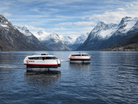
Norway’s coastal commuters are about to experience one of the most ambitious leaps in clean transport in recent years.
Norwegian public transport firm Boreal AS has ordered 20 zero-emission Candela P‑12 hydrofoil ferries, in a deal that marks a new frontier in electric mobility at sea, blending aerodynamic innovation with next-generation energy efficiency.
For travellers accustomed to breath-taking fjord backdrops, the sensation of gliding above the waves might make the daily commute feel close to flying.
Built in Sweden, the Candela P‑12 electric hydrofoil has been described as a “magic carpet” for passengers. It is a vessel designed to make high-speed, zero‑emission travel both commercially and environmentally viable.
Reshaping energy use at sea
While Norway has already written the rulebook for the adoption of EVs, maritime electrification has proved a more stubborn challenge.
The country’s fast ferries, which are absolutely vital for communities along more than 100,000 miles of coastline, have long relied on diesel to meet their range and speed demands. Boreal AS is looking to change that narrative.
The company’s investment in the P‑12 fleet draws on Candela’s hydrofoil technology, which cuts drag by 80% and slashes energy use to levels once thought unreachable for high-speed routes.
By lifting the hull above the water, these craft reduce resistance so dramatically that purely electric operation becomes not only possible but practical.
“Norway has already led the electrification of maritime transport," says Nikolai Knudsmoen Utheim, CEO of Boreal. "With this fleet, Boreal wants to take the next step – accelerating zero‑emission high-speed travel along the Norwegian coast."

High efficiency, low impact
The P‑12’s environmental advantages extend beyond its lack of tailpipe emissions.
Because the hull rides on computer‑controlled hydrofoils, the vessel glides with minimal wake and near‑silence – critical in the delicate ecosystems of the Norwegian fjords.
Traditional high‑speed craft often cause shoreline erosion and noise pollution; the P‑12’s design avoids both with impressive poise.
At speeds above 18 knots, its wings lift the hull and maintain stability through real‑time adjustments, allowing a cruising range of 40 nautical miles at 25 knots.
“Tourists and commuters will enjoy service without the negative impacts of wake and emissions in the unique Norwegian fjords,” says Alexander Sifvert, Candela’s European Director.
For operators, the 80% reduction in energy consumption represents major progress – not only in emissions but also in cost control and operational predictability, key pillars of long-term sustainability strategies.
The customer experience
The P‑12 has been engineered as much for human comfort as for environmental impact. In tests around Stockholm, the vessel’s cabin registered just 64 decibels – quieter than a modern train.
The quiet, smooth ride transforms the character of maritime travel: steady, stable and kind to passengers and shorelines alike.
“Tourists and commuters in Norway will enjoy better service and more frequent departures – free from seasickness, silent,” adds Alexander.
Gustav Hasselskog, Founder and CEO at Candela, describes the experience in almost-dreamlike terms. “If there ever was a magic carpet, we’ve made it."
The Flight controller system constantly adjusts the hydrofoils to keep the cabin level, even in rough seas – allowing for consistent performance and fewer weather-related cancellations.
Building energy networks for the sea
The 20‑vessel order will roll out in stages from 2027 through 2030, forming the world’s largest electric hydrofoil fleet.
Perhaps most strikingly, each P‑12 can recharge in about an hour using standard DC car chargers, avoiding the heavy infrastructure burden of megawatt-scale systems typically required for large electric ferries.
That flexibility was demonstrated during a record-setting demonstration between Sweden and Norway, where a P‑12 completed the longest electric sea journey to date, recharging along the way via a mobile battery unit transported by a Ford F‑150 Lightning pickup.
“Candela P‑12 is the only electric passenger vessel that combines longer range with high speed without requiring extensive charging infrastructure," says Nikolai. "Our investment will enable new high-speed routes both in cities and in rural areas."
Project engineer Gabriele De Mattia highlights the broader energy implications: "In many cases, building megawatt-scale chargers – especially where the grid is weak or undeveloped – can cost as much as the vessels themselves.
"The breakthrough with P‑12 is that it is fast to charge and extremely flexible in where it can operate."
Company portals

Executives
Gustav Hasselskog
Founder & CEO