Could a Giant Plane be the Future of Wind Turbine Transport?
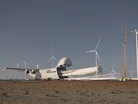
The ground transport infrastructure currently in place is designed for standard logistics operations, not the exceptional dimensions of today's oversized cargo requirements.
Supply chains face mounting challenges as global demands evolve, particularly in the renewable energy sector where the scale of wind turbine components creates delivery obstacles.
Radia, founded in 2016 by aerospace engineer Mark Lundstrom, aims to address this challenge through WindRunner, an aircraft purpose-built to transport the world's largest wind turbine blades to sites that remain inaccessible via conventional road or rail networks.
Existing infrastructure can only accommodate blades measuring approximately 70 metres in length.

The next generation of turbines, featuring blades exceeding 100 metres, necessitates a fundamental reassessment of logistics capabilities.
Unlocking new supply chains
The aircraft addresses supply chain constraints currently overwhelmed by the weight and dimensions of wind turbine blades that standard ground transportation systems cannot manage.
Its design allows for the carriage of turbine blades exceeding 105 metres and enables landing on unpaved, semi-prepared runways as short as 1,800 metres.
The aircraft provides 7,700 cubic metres of cargo capacity, roughly 10 times the volume of a Boeing 777, with a payload capacity ranging between 72.6 and 80 tonnes.
This capability could enable direct delivery to locations far removed from ports or major road networks, potentially reducing the requirement for complex last-mile logistics operations.
Radia presented WindRunner publicly at the 2025 Paris Air Show and targets a maiden flight in 2029, with service entry anticipated in the early 2030s.
GigaWind deployment
The aircraft holds particular relevance for onshore wind energy, which provides a simpler, lower-maintenance option compared to offshore installations.
The persistent challenge remains: transporting these substantial components to inland sites.
GigaWind, Radia’s term for its broader initiative, is the answer.
It refers to onshore deployment of the largest turbines ever used, taking scale benefits seen offshore and making them work inland. That means longer blades, taller turbines and greater output.
Wind energy's value proposition lies in its combination of consistency and cost-effectiveness.
With high-capacity factors and low production costs, it operates both within and beyond traditional electricity grids.
According to Radia, wind could support not only power generation but emerging applications including data centres and green fuel production.
Addressing logistics obstacles
WindRunner's function extends beyond transporting wind turbine components.
It could address one of the primary barriers to clean energy expansion: logistics constraints.
In 2023, Siemens Gamesa Chief Operating Officer Tim Dawidowsky explained: “Big Western wind turbine makers need direct financial support to make the investments needed to aid decarbonisation.
"The supply chain is facing substantial challenges that could limit production capacity and increase turbine prices.”
Through enabling direct delivery of larger blades to remote locations, WindRunner could remove a persistent obstacle.
It bypasses congested road networks and bridges, avoids rail system limitations and eliminates the requirement for expensive infrastructure modifications solely to access construction sites.
This development could also improve the cost profile. Taller turbines equipped with longer blades generate more energy with greater consistency, delivering what Radia describes as a "step function improvement" in both output and reliability.
Beyond renewable energy applications
WindRunner's applications need not be limited to the energy sector.
Its substantial cargo bay and rugged landing capabilities could suit other oversized loads, including military payloads, disaster relief materials and large aerospace components.
Founder and CEO Mark Lundstrom adds: “We are essentially looking at building a platform for moving the biggest things in the world in the hardest-to-reach places.
"Wind turbines are some of the biggest ones, but there are other large military payloads as well.”
Supported by more than US$150m in funding, Radia has secured early investment from firms including LS Power, ConocoPhillips, Capital Factory, Caruso Ventures and Good Growth Capital.
A Series C funding round aims to raise up to US$300m, with proceeds allocated toward accelerating aircraft development.
WindRunner's advancement relies on partnerships with aerospace companies including Leonardo, AFuzion and Aernnova, covering aircraft design, certification and engineering support.
Alongside these partnerships exists a developing network of suppliers forming a global delivery chain suited to this oversized mission.
Company portals

Executives
Mark Lundstrom
Founder and CEO