

How Vaishali Sinha Built Indian Renewables Giant ReNew
How Vaishali Sinha Built Indian Renewables Giant ReNew
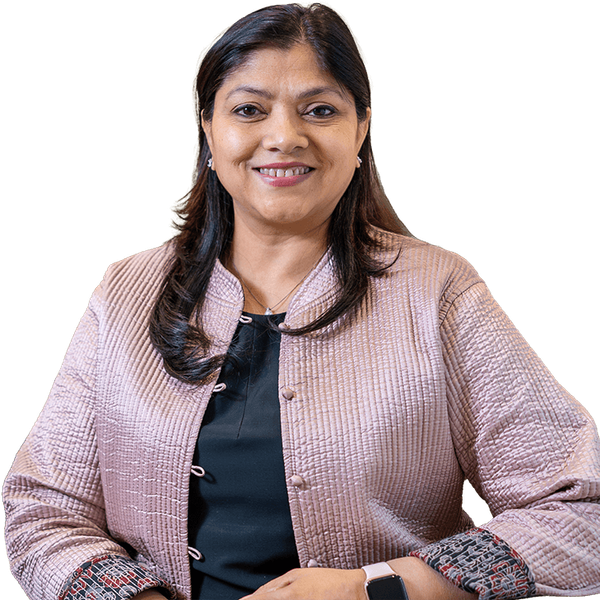
As Co-Founder of ReNew, the second largest renewable energy company in India, Vaishali Nigam Sinha is one of the most influential figures working in the global energy sector.
It is perhaps surprising, then, that she took the long road to becoming the energy pioneer she is today.
Vaishali arrived in the sector after years in finance, spending time on Wall Street and in London after securing a master’s degree at Columbia University. Eventually, however, she began to feel a growing unease with a job measured in deals closed and books balanced.
The result is a career that feels less like a pivot than an epiphany. From the beginning, her story has been shaped by a question that never quite went away: what is a life for, if not to leave something better behind?
At ReNew, Vaishali chairs the company’s sustainability function and its charitable foundation, and she also serves as President of the United Nations Global Compact Network India, a role that carries its own significance.
She is the first person from the private sector to hold the post, as well as the first woman, which is something she admits to feeling “slightly proud” of. That said, purpose, rather than pride, is the dominant theme of Vaishali’s story.
From India to Columbia
Vaishali grew up in India, studied there and initially wanted to pursue international relations. That path took her to Columbia University in New York, where she completed a master’s degree in Public Policy on a scholarship from the American Association of University Women.
Even before her corporate career began, she had already shown an interest in environmental issues.
“While I was in college, I was interested in sustainability,” she recalls. “It wasn’t really a thing then. But I really found it interesting and very calming. It was just a hobby, a part of my college work.” That early curiosity would later return with much greater force.
For a decade, however, Vaishali lived in the world of finance, which she describes as both intellectually exciting and personally demanding.
The work was rewarding, but after years of living by the logic of markets and transactions, she found the question of purpose impossible to ignore.
The accidental founder
ReNew began not as a grand ideological project but as a practical idea shaped by experience. Vaishali’s husband, Sumant Sinha, who was then CEO of Suzlon, wanted them to build something of their own.
At the time, sustainability was becoming a subject of interest, but not yet a sector many people believed could stand on its own two feet.
“People in government or in business thought it was a ‘nice to do’. But nobody thought you could actually make money from a sustainability-related business,” she explains. Nevertheless, that uncertainty did not deter them. Instead, it sharpened their thinking.
“If you’re very comfortable with something, the opportunity to create value isn’t as great,” she adds. “And if something isn’t really understood by the ecosystem, but you have the conviction, then perhaps you must go for it.” That idea was the seed for ReNew’s founding.
Vaishali was not, by her own account, the obvious candidate to help run it. “I thought there was no real role for me at ReNew. I hadn’t been an engineer, hadn’t had any experience in that space.”
At first, the company was connected to a financial services advisory platform, which made sense given her background. But once Goldman Sachs funded the business, and funded it at five times the amount requested, the scale of the opportunity changed.
“Suddenly there was a huge amount to be done and we were a small team, so I got sucked into ReNew accidentally, not intentionally,” she says. “But as they say, the rest is history.”
Learning the terrain
The early years of ReNew were anything but simple.
An old adage in the world of business is that “the first million is the hardest”. In the world of energy, the same is true for the first 100 megawatts.
Establishing an energy provider from the ground up demands a different kind of work, one rooted in geography, politics and people, rather than spreadsheets.
“Acquiring land, engaging with communities, dealing with people, it wasn’t something we’d done in the past,” she says. “It was a steep learning curve.”
“We were very clear that we wanted to do good business, but also in a good way, a clean energy business done in a clean way, with good governance, good community engagement and community values.”
The company was also building in a sector that was, at the time, very short of experienced engineers. “There was no track record of people in the sector because the sector didn’t exist,” Vaishali recalls.
“So while we didn’t have a capital problem, which is what most people have, we did have an issue of finding people with the experience and understanding of how to get things done on the ground.”
If you’re very comfortable with something, the opportunity to create value isn’t as great.
The meteoric rise of ReNew
Since those early days, ReNew’s growth has been extraordinary. From the company’s first wind projects in Gujarat, ReNew has expanded to roughly 14GW of installed assets and more than 20GW in its pipeline.
But Vaishali is careful not to frame scale as the sole measure of success. What mattered was building something credible enough to influence the wider ecosystem.
“We were batting for the sector, not necessarily just the company, and that’s what was helpful,” she says. “Not only for us to grow, but for the sector to grow.” That spirit of sector building helped align ReNew with India’s own energy transition, as policy evolved from ambition to execution.
The country’s renewable targets rose sharply, from 175GW, to 250 and then to 500. ReNew has become one of the companies helping turn those numbers into reality.
The company’s evolution also reflects a broader strategic shift. It began as ReNew Wind Power, became ReNew Power and later simply ReNew. More than stylistic, the rebranding marked a move beyond electricity generation towards what Vaishali calls “decarbonisation solutions”.
“An IPP is just using solar and wind to generate electricity,” she says. “But we were moving from electrons to molecules as well.” That meant green hydrogen, battery storage, solar manufacturing, emissions management and partnerships with customers outside the grid, including heavy industry and technology companies with demanding green power needs.”
“It was really about decarbonisation,” she says. “We felt that moving from being an IPP to being a decarbonisation partner to various stakeholders was the opportunity.”
Realism over rhetoric
Vaishali’s view of the energy transition is rooted in realism rather than slogans. She describes how India’s 2070 net zero target is a development strategy in a country still working to extend electricity access and economic opportunity. “You have a country with a lot of people below the poverty line, a lot of people without access to electricity. So it was about electricity access first, not just clean electricity,” she says.
As prices fell and renewables became economically attractive, India’s energy transition started to gain momentum. “When the pricing curve bent in favour of renewables, it became an economic imperative,” she says.
That is why she pushes back against the idea that sustainability can be treated as a side project. “Setting a net zero goal for 2050 means nothing if you’re not going to achieve it,” she says. “You have to set realistic goals.”
ReNew’s own ambitions are equally concrete. It is aiming for net zero by 2040 – a goal that has been validated by the SBTi – and its business is built around that ambition.

Women, work and transition
For Vaishali, the clean energy transition is also a question of inclusion. She speaks with particular verve about women in energy, arguing that climate action is an impossibility without them. “You can’t solve these problems by leaving 50% of the population behind,” she says. “That’s a cliché, but it’s really true.”
Her examples are grounded in lived realities. Women in rural India, she argues, are already managing the consequences of climate change, even if they are rarely invited to shape the response.
“They do all the work. They face the consequences. If there’s a drought, they’re the ones who pack up the family and move,” she says. “They know what to do and how to solve problems. But they’re never consulted for solutions, at any level.”
You can’t solve these problems by leaving 50% of the population behind.
At ReNew, Vaishali has helped to set up programmes to bring more women into the fold, such as reskilling women in salt pan farming in Gujarat for solar jobs. Elsewhere, in coal mining regions, ReNew is working with IIT Dhanbad to build pathways for women and families into new careers. The company has set a goal of having 30% of its workforce be women by 2030.
As proud as Vaishali is about how ReNew cares for its people, she is equally proud of how much she sees young people caring for the planet. “It's really encouraging to see young people these days who are driven by purpose,” she says.
As such, she feels as though ReNew and the climate movement will be in safe hands for years to come. “When you hire young people from top institutions in India, it's really not only about money and wanting to be in the largest hedge fund. People genuinely care about companies doing good business. That's the good news.”
Company portals

Executives
Vaishali Nigam Sinha
Co Founder and Chairperson Sustainability