
How Rolls-Royce SMR Manufactures its Nuclear Reactors
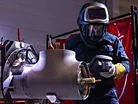
While Rolls-Royce is most commonly associated with luxury cars, the British company has become a major player in the field of nuclear energy in recent years.
After winning a lucrative UK Government contract to develop and install three small modular reactors in North Wales, as well as several more across Europe, the firm has decided to heavily invest in its manufacturing capabilities.
Rolls-Royce SMR’s Pioneer Works facility in Derby will serve as its first dedicated manufacturing development centre, focused on refining production methods, assembly techniques and testing processes critical to energy generation systems.
The £12m (US$15.8m) site is expected to open later this year and has been designed to reduce delivery risk for SMR deployment programmes in the UK, Czechia and Sweden.

As countries accelerate efforts to decarbonise energy systems, SMRs are gaining traction as a scalable alternative to traditional nuclear plants, which often involve long build times and high capital costs. By enabling faster deployment and lower upfront investment, they are increasingly seen as a practical route to expanding low carbon baseload power capacity.
How Rolls-Royce manufactures SMRs
Rolls-Royce SMR’s Pioneer Works facility in Derby will operate as a non-nuclear site dedicated to advanced engineering and manufacturing activities that underpin energy infrastructure.
The company expects the site to create around 40 highly-skilled, long-term roles across disciplines including welding, testing, precision assembly and manufacturing development.
Its primary function is to develop and validate the manufacturing processes required to assemble the reactor’s primary circuit, a critical component in nuclear energy generation.
The facility will work alongside Rolls-Royce SMR’s existing ‘EXPERI’ site at the University of Sheffield’s Advanced Manufacturing Research Centre, strengthening the UK’s nuclear innovation ecosystem.
Ruth Todd CBE, Rolls-Royce SMR’s Operations and Supply Chain Director, says: “Pioneer Works will be at the centre of our ambition to transform the way nuclear projects are delivered, creating highly-skilled jobs, supporting the wider supply chain and harnessing British engineering know-how to drive forward the next generation of nuclear power.
“I’m also incredibly proud that this facility will act as our first training centre to create a future workforce which will help build Rolls-Royce SMR’s ‘factory-built’ nuclear power plants around the world.”
Why SMRs matter
SMRs are nuclear fission reactors typically producing up to 300 megawatts (MW) of electricity per unit, according to the IEA, positioning them as flexible assets within modern energy grids.
Rolls-Royce states its SMR design delivers 470 MW per unit, providing enough capacity to support significant portions of regional electricity demand.
A defining feature of SMRs is their modular design, allowing components to be manufactured in controlled factory environments and then transported for installation.
Rolls-Royce SMR says its approach enables around 90% of each plant to be fabricated and tested off-site, improving quality control and accelerating deployment timelines.
Consulting giant McKinsey highlights that this model can reduce both construction time and the upfront costs associated with nuclear energy projects, making them more viable within evolving energy markets.

Global push for nuclear capacity
Nuclear power is increasingly central to long-term energy strategies, with more than 30 countries aiming to triple nuclear capacity by 2050, according to the World Nuclear Association.
This expansion is driven by the need for reliable, low carbon electricity to complement renewable energy sources and support electrification across industries.
Countries including the US, China, Japan, the UK, Sweden and the Czech Republic are among those pursuing major nuclear growth programmes.
Rolls-Royce SMR confirmed in 2026 that it has secured contracts to deploy SMRs in Sweden and the Czech Republic, reinforcing its position in the global energy market.
Strengthening the UK's energy infrastructure
In the UK, Rolls-Royce SMR represents the first domestically developed nuclear technology in over two decades, marking a significant milestone for national energy independence and security.
The programme also supports broader industrial growth, linking advanced manufacturing with the transition to low carbon energy.
Catherine Atkinson, UK Member of Parliament for Derby North, says: “Pioneer Works will bring skilled jobs and training opportunities to Derby, while putting our city at the centre of one of the biggest engineering opportunities of the coming years.”
Rolls-Royce estimates each SMR unit can generate enough low carbon electricity to power one million homes for at least 60 years, underlining its long-term contribution to the UK’s energy mix.
In April, the company signed an agreement with Great British Energy Nuclear to begin site-specific design and delivery work for the UK’s first SMRs at Wylfa in North Wales, signalling tangible progress towards deployment.
Company portals

Executives

Ruth Todd
Operations & Supply Chain Director at Rolls-Royce SMR