How Do Extreme Temperatures Affect EV Battery Perfomance?
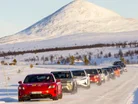
This month, in the mountain air of Norway's Folldal region, temperatures have plummeted to an inhospitable -32°C.
These are conditions that humans can scarcely survive. That, however, has not dampened adventurous spirits of the world's EV companies.
Across several snow-packed days, 24 EVs lined up for the Winter El Prix 2026, a cold-weather trial run by the Norges Automobil‑Forbund (NAF) and Motor Magazine.
The goal of the race was simply to measure how extremely cold weather affects the battery range, energy efficiency and charge performance of this cohort of electric vehicles.

While most of the worlds people-carrying EVs do not encounter such weather too often, the race has functioned like a study in endurance and technology for the sector.
“The future of mobility is constantly changing,” says Willem Groenewald, FIA Secretary General for Automobile Mobility and Sustainability.
“Providing consumers with essential data on new technologies, such as improved performance of EVs, is key for shaping selection and choice for road users.
“It is also testament to the adaptability of manufacturers to drive innovation forward to the ultimate benefit of consumers, not only in battery improvements but also in terms of safety standards."
When battery chemistry slows down
In a test like this, power output and molecular physics meet face to face. Inside every battery pack, the electrolyte fluid thickens as temperatures fall.
Ions move more sluggishly, internal resistance rises and the whole system draws more energy simply to keep active.
To protect themselves, batteries limit how fast they accept a charge when frozen.
That’s why many EVs now rely on preconditioning software, which gently warms the pack before charging so current can flow more freely.
Unlike petrol cars, where heat is a by-product, EVs must devote stored energy to cabin warmth. On the iciest mornings, heating the interior can swallow as much as two‑thirds of an EV’s extra winter consumption.

A measured drop, not a malfunction
Every car in the trial lost distance compared to its standard WLTP range, but the decline told its own story rather than a failure of technology.
Across the fleet, range dropped by an average of 38%. With vehicles left outdoors overnight at -25°C, the exercise mirrored real life for northern European drivers.
Temperatures may have gripped the battery chemistry, but reliability held strong. Heating systems worked, electronics stayed stable and there wasn’t a single technical collapse in 24 vehicles.
Tor Arne Litlere, NAF President, sums it up: “El Prix provides motorists with invaluable data and insight into how EVs truly perform when tested to their limit in the harshest Nordic conditions.
“Situation based knowledge about the deviations from WLTP range is a true value for members and road users from these tests.”
Charging in the deep freeze
Perhaps the most encouraging data of all came from the fast-charging tests. With batteries preheated, most EVs hit their promised 10–80% charge times, even with frost crawling across the connectors.
A few reached peak draws of 350 kW and even 400 kW, pushing energy through cables almost as fast as under summer conditions.
For network operators and fleet managers, those figures matter.
They hint at an emerging truth: that the northern grid – and the next wave of EV infrastructure – can handle demand even in deep winter, provided smart preconditioning becomes standard.
Who came out on top?
The Lucid Air Grand Touring led the field on distance, cruising nearly 100 kilometres further than its nearest rival—but it also took one of the steepest hits against its lab-tested range.
More modest models stole the efficiency spotlight: Kia’s compact EV2 prototype achieved 310 kilometres, deviating just 24.8% from its WLTP rating.
That balance between ambition and practicality was echoed by the MG 6S EV and Hyundai Inster, both losing only 29% of range.
Most impressive of all, the Changan DEEPAL S05 hit its official charge time exactly – 23 minutes flat.
Meanwhile, the Kia EV2 and EV4 both performed within minutes of their expected figures, confirming that heat management design now counts as much as raw battery capacity.
A shared roadmap for cold‑climate energy
The 2026 El Prix was more international than ever. Through its Co‑Driver Programme, the NAF pulled in partners from Canada, Denmark, Iceland, Belgium and Austria, pooling data that will inform energy planners across the northern hemisphere.
The lessons stretch far beyond car buyers. As governments and utilities look to harden transport infrastructure against cold snaps, the findings from Folldal show how electrification can thrive even at sub‑arctic extremes.
This biannual study – run again in the summer – now serves as a living benchmark for how energy storage, grid resilience and consumer confidence evolve together as the EV transition accelerates.





Executives
Willem Groenewald
Secretary General for Automobile Mobility and Sustainability