
Are Iron Batteries the Answer to Critical Metal Scarcity?
"The most exciting clean tech innovation of 2025? It might just be rust."
That was the assessment of Mark Loveridge, Commercial Director of Renewable Exchange, when asked about climate technology late last year. Six months on, the rust revolution he predicted has not just continued but gathered a momentum.
But what exactly was Mark referring to? The innovation in question was iron-air batteries, a deceptively simple but radically effective form of energy storage.
And, within the context of the energy transition, storage is the watchword of the moment.
The problem with renewable energy systems as things stand is that, unlike fossil fuels, renewable energies like solar and wind are difficult to store in the quantities we need.
This means that when the sun does not shine and the wind drops, energy supplies can run low.
The renewable energy storage problem
For decades, the energy storage conversation has been ruled by the lithium-ion cell, a technology that powers everything from our mobile phones to electric vehicles.
But with 2026 now firmly underway, a chemically distinct contender has moved decisively from the laboratory to the electrical grid.
"After decades of dominance by lithium-ion, 2025 was potentially the turning point for long-duration energy storage (LDES), and iron-air batteries are leading the charge," Mark says.
The premise is elegantly simple, in the way that the world's best inventions often are. These batteries harness the process of reversible rusting. During discharge, the battery "breathes" in oxygen from the air which converts iron pellets into rust and releases energy.
To charge, an electrical current turns the rust back into metallic iron and the battery "exhales" oxygen.

The unique capabilities of iron-air batteries
The primary limitation of lithium-ion technology is its duration. While excellent for short bursts of power lasting two to four hours, lithium-ion becomes prohibitively expensive when trying to bridge multi-day gaps in renewable generation.
This is where iron-air technology finds its niche.
"They're capable of storing energy for 100+ hours – enabling wind and solar to keep the lights on, even when the sun doesn't shine or the wind doesn't blow," Mark explains.
By offering a duration that is orders of magnitude longer than conventional batteries, iron-air systems can replace fossil fuel peaker plants.
"Ideal for grid-scale decarbonisation, especially during multi-day renewable lulls," Mark adds.
From theory to practice
The technology has moved rapidly from theoretical models to concrete infrastructure. By the end of last year, Form Energy had recently raised over US$400m and was fulfilling its first orders for major utilities including Xcel Energy and Georgia Power. Since then, things have moved quickly.
Form has now launched full commercial production at its factory in Weirton, West Virginia – on the site of a former steel mill – and has commenced delivery of its first commercial pilot system in Minnesota, with the full project expected to come online later this year.
The Weirton plant, known as Form Factory 1, is on track to reach an annual production capacity of 500MW by 2028.
With more than 75GWh of commercial projects now under agreement, Form Energy has proven that its technology works. More importantly, though, it has also proved that the world wants more.
Big tech bets on iron and air
Perhaps the most striking sign of that demand came in February 2026, when Google and utility Xcel Energy announced plans to build what has been described as the largest battery project by energy capacity ever announced globally.
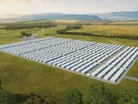
The 300MW, 30GWh deployment in Pine Island, Minnesota was built using Form's iron-air technology and is part of a broader agreement to supply clean power to a new Google data centre, backed by 1,900MW of new renewable energy resources funded by Google itself.
To put that figure into context: the Pine Island project, fully charged, would hold enough energy to power the equivalent of a small city through days of cloud cover and still weather.
The batteries will provide what Form calls "firm capacity". For the layperson, that means reliable, dispatchable energy during the multi-day stress events that solar and wind simply cannot cover on their own.
The Weirton factory will produce all the batteries for this project, with deliveries expected to begin in 2028 and installations to come online in phases through to 2031.
Within weeks of that announcement, Form was back in the headlines.
At CERAWeek 2026 in Houston (widely regarded as the energy industry's most significant annual gathering) the company announced a further strategic capacity agreement with Crusoe, an AI infrastructure developer, to supply 12GWh of iron-air batteries for AI data centres starting in 2027.
Mateo Jaramillo, the company's Co-Founder and CEO, was very enthusiastic about the partnership at the time.
“Powering the AI economy requires reliable, scalable and cost-effective energy solutions,” he said.
“This partnership with Crusoe, a market leader in energy-first AI infrastructure, demonstrates how multi-day energy storage can unlock new capacity for data centres while strengthening domestic manufacturing and delivering the firm, reliable power needed to support the next generation of AI infrastructure.”
The geopolitics of abundance
Beyond the technical specifications, the iron-air battery offers a significant geopolitical advantage.
The transition to clean energy has often meant trading a dependency on fossil fuels for a dependency on critical metals like lithium, cobalt and nickel, all of which are growing scarcer and more contested.
Iron-air batteries sidestep this scarcity trap entirely, being made using only abundant, inexpensive materials – iron, air and water.
With lithium prices rising sharply in early 2026, iron looks like a far more attractive proposition.
This abundance translates to stability and security for national energy strategies, reducing conflict and streamlining supply chains. What's more, the environmental profile of these batteries aligns closely with circular economy principles simply because their active materials are non-toxic and easily recyclable at the end of the system's life.
A heavyweight contender
It is important to note that these batteries are not designed to be used in EVs or smartphones.
They are also heavy, bulky and relatively inefficient compared to their lithium counterparts. Iron-air systems currently achieve a round-trip efficiency of around 40–50%, meaning that for every 10MWh of energy stored, only four to five are returned on discharge.
For applications where energy density and efficiency are paramount, this remains a genuine limitation. But for a static asset sitting on a concrete pad next to a wind farm, or one that powers a data centre, these trade-offs look very different.
The cost per kilowatt-hour remains the deciding factor and iron-air targets a price point of less than US$20/kWh, a fraction of the cost of lithium-ion. That kind of return allows utilities to store vast amounts of energy without bankrupting the grid.
More importantly, pivoting away from rare earth minerals frees those resources up for use in climate technologies where there are no other alternatives.
As we look to the future, it is possible that the reliable, sustainable power grids we are looking for will be built using the most common metal on Earth.
"For those watching the future of energy: keep an eye on iron-air," Mark says. "It's not just innovative, it's potentially transformative for the sector."
Company portals

Executives

Mark Loveridge
Commercial Director

Mateo Jaramillo
CEO