Hitachi Energy: How Data Centres Can Be Better Grid Citizens

The rise of AI has fast become one of the most pressing and intractable challenges the energy sector has ever faced, affecting every stakeholder from grid operators, to energy providers, to urban planners.
Data centres, especially AI data centres, are some of the largest and most demanding consumers of electricity that have ever been connected to the grid.
While a conventional data centre can draw as much power as 100,000 homes, the IEA estimates that some AI campuses now being built could require up to 20 times that amount.
But scale is not the only problem here. AI facilities create highly variable load patterns (sporadic fluctuations in the demand for energy) that can change dramatically depending on whether systems are training large models or serving live applications.
That kind of volatility has left the sector with some tough questions to answer.
Firstly, where should these facilities be connected? How much storage should sit on-site? What sort of infrastructure upgrades are needed? How do we make sure fluctuations in demand do not disturb the wider network?
- While a conventional data centre can pull as much power as 100,000 homes, the International Energy Agency estimates AI campuses currently under construction demanding up to 20 times that amount.
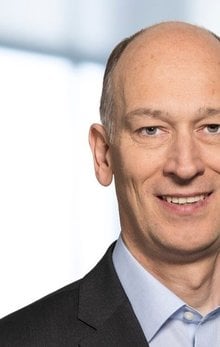
Gerhard Salge, Chief Technology Officer at Hitachi Energy, is looking to provide answers.
“Technology providers like us with system experience can help data centres not only by supplying the technology but also to build a trustful relationship in between developers, operators and utilities,” he says.
Originally from Germany and now based in Switzerland, Gerhard brings a background in electrical engineering and three decades of industry experience to the role.
Looking back on that career, he jokes about the pace of change in the sector: “The nice thing is you learn a lot in that time, the bad thing is you’re old.”
Yet that long-term perspective is increasingly valuable as power networks adapt to the demands of AI.
Making AI data centres 'better grid citizens'
For Hitachi Energy, the priority is to ensure that AI facilities become what Gerhard calls “better grid citizens”.
In effect, this refers to large electricity users that actively coordinate with utilities rather than simply consuming power whenever it is needed.
Unlike household demand, the connection of a major AI campus can have a noticeable impact on the surrounding network.
“When you connect a small home to the power grid, the utility company barely notices,” Gerhard explains. “But a data centre uses so much power that it can easily stress the grid, especially when its power needs suddenly spike or drop.”
That means energy companies, grid operators and developers must work together from the earliest planning stages.
“To be a ‘good citizen’ and a good partner, data centres need to work closely with power companies from day one," Gerhard says.
“They need to plan how to manage these big changes in energy use so they don't disrupt the grid. Because we understand what utility companies need, we can work with NVIDIA and others to build smarter data centres that are better for the power grid.”
Hitachi Energy's work with NVIDIA
Hitachi Energy’s collaboration with NVIDIA centres on a new 800-volt architecture, designed for next-generation AI facilities.
This kind of system is capable of delivering power faster and more efficiently. In fact, NVIDIA says this kind of architecture can reduce facility-wide energy losses by 5%.
Although existing equipment can support 800-volt systems, deploying them at the density required by modern AI campuses presents a different challenge.
“With today’s available products and solutions, you can supply an 800-volt architecture,” Gerhard explains.
“There are transformers, converters and UPS [uninterruptible power supply] systems available where you can connect an 800-volt system into an existing, conventional set of solutions. But where innovation is required and being evaluated is when you hit space constraints – specifically when you want to build it more dense and concentrated.”
Higher energy density inevitably creates engineering trade-offs between cost, space and technology readiness.
To address those constraints, Hitachi Energy and NVIDIA are exploring new hardware concepts, including more compact power converters and emerging solid-state transformer technologies.
“This is what we are discussing with NVIDIA – looking into which types of concepts you can use in order to shrink converter sizes,” Gerhard says.
“One of the very popular discussions these days is what you can achieve with solid-state transformer concepts, and that is also something we are looking at together with NVIDIA and others.”

Defending the grid
As AI computing continues to expand, the challenge facing electricity networks extends well beyond supplying enough power.
Today, utilities also have to ensure that the unpredictable demand for energy does not undermine power quality or wider grid stability.
According to Gerhard, this is where advanced power electronics will play a central role in those efforts.
Technologies including Static Synchronous Compensators (STATCOMs) and High-Voltage Direct Current (HVDC) systems are becoming essential tools for separating the highly dynamic behaviour of AI data centres from the public electricity network.
“What you do in this power electronics is you are going from an AC voltage to a DC voltage or the other way around or both,” Gerhard explains.
By converting electricity between alternating current and direct current, these systems create an electrical buffer that shields the wider grid from the rapid fluctuations associated with AI processing.

Rather than allowing fluctuations to ripple through transmission and distribution networks, the right kind of power electronics can manage the it before it ever becomes a problem.
Gerhard says these technologies are specifically designed to cope with the “potential bursts of AI GPUs which are coming”.
Coupled with on-site energy storage, they provide the flexibility to absorb sudden surges in demand or release stored electricity whenever workloads increase unexpectedly.
“The energy storage can either absorb or feed such a burst and then the other side of the power electronics converter doesn't see that disturbance anymore,” Gerhard explains.
The result is a far more stable operating environment for both utilities and neighbouring electricity users, allowing AI infrastructure to expand without creating disruptive fluctuations across the network.
Moving renewable power where it is needed
While STATCOM technology protects local grid stability, HVDC addresses a different challenge: transporting large volumes of electricity over long distances with minimal transmission losses.
As such, access to reliable power is becoming just as important as access to land or fibre connectivity.
That is placing greater emphasis on transmission networks capable of moving renewable electricity from areas of abundant generation to regions where demand is rising fastest.
Rather than viewing AI data centres in isolation, Gerhard sees them as part of a much broader transformation of the electricity system.
India illustrates this shift particularly well. The country is planning significant investment in solar generation alongside new HVDC transmission corridors capable of delivering renewable electricity directly to major cities, industrial centres and future data centre developments.
By combining long-distance transmission with advanced power electronics at the point of consumption, operators can optimise both network efficiency and system resilience.
“You have them both,” Gerhard says. “You have the transport over long distances with best optimised low losses and also the power electronics to filter out disturbances. So that is what these grid-enhancing technologies are.”
Balancing renewable power around the clock
Meeting the growing electricity needs of AI data centres with renewable energy is a huge challenge for the sector.
While wind and solar offer abundant low-carbon generation, their variable nature means grid operators must continually balance supply with demand when weather conditions change.
Rather than depending on a single renewable technology, Gerhard suggests that power networks should combine resources such as solar, wind and hydropower, allowing one source to compensate when another produces less electricity.
“The wider the area, the more complementary your sources, the better you can balance changes out,” he says.
Another key consideration in the decarbonisation of data centres is energy storage.
Combining renewable generation with storage creates a pathway towards balancing the energy triangle by strengthening security of supply while supporting affordability and sustainability.
With wind and solar now among the lowest-cost forms of electricity generation, integrating larger volumes of renewable power has the potential to reduce overall system costs, provided electricity can be transported efficiently to where it is needed.
According to Gerhard, achieving that objective depends on stronger interconnection between regional power systems.
Larger transmission networks enable operators to move electricity across wider geographical areas, making better use of renewable resources while reducing the impact of local variations in supply and demand.
Gerhard points to the benefits already demonstrated through interconnection between countries including the UK, France and Germany, where cross-border transmission allows electricity to flow to regions experiencing the greatest need.
By doing this, Gerhard says “you gain a lot of efficiency and a lot of cost effectiveness”.
As countries invest simultaneously in renewable generation, transmission infrastructure and digital connectivity, regions with abundant clean electricity are becoming increasingly attractive locations for future AI investment.
Again, Gerhard points to India as an example of best practice.
“The Indian Government and Indian companies are planning a lot of new data centres,” he says, pointing to the country's ambitious renewable energy programmes and continued investment in electricity infrastructure.
“India is on the way to become an electrostate.”