How Aramco Posted Huge Profits Despite the Hormuz Closure
Few companies are more central to how the world powers itself than Saudi Aramco.
In the century since its founding, it has become, by almost any measure, the most consequential energy business on the planet.
It is the largest oil and gas producer in the world, with a production volume of 12.4 million barrels of oil equivalent per day in 2024, and its 4.1 million barrel per day net refining capacity makes it the world's fourth-largest refiner.
However, when joint US-Israeli strikes on Iran kickstarted conflict across the Middle East at the end of February, the company's operations were immediately impacted.
While Saudi itself has not joined the fighting, its supply line through the Strait of Hormuz (the waterway through which the vast majority of Middle Eastern oil and gas ordinarily passes) has been effectively closed, leaving the country without its go-to trade route for its number one export.
The consequences for global supply chains have been severe. Over the past two months, an estimated one billion barrels of oil have been removed from global markets, according to executives from the world's biggest oil companies.
But despite all the upheaval, Aramco has just posted a 25% jump in profits for the first quarter of 2026.
The question, then, is how has Aramco offloaded its products since the war began? And more to the point, what is the company's strategy going forward, should disruption continue to rule the region for the foreseeable future?
- Employees: 76,000
- HQ: Dhahran, Saudi Arabia
- Production capacity: 12.4 million barrels of oil per day
- Refining capacity: 4.1 million barrels of oil per day
- Operational reach: More than 50 countries
Aramco's response to the US-Israel-Iran war
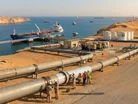
Faced with a halt to exports through its Gulf ports, Aramco has turned to its East-West Pipeline – a piece of infrastructure that has been critical in keeping the firm's supplies moving.
The pipeline has allowed Aramco to transport crude oil from its eastern operations to the Red Sea port of Yanbu, bypassing the Strait of Hormuz altogether.
Amin Nasser, Aramco's President and CEO, described its importance in stark terms during the company's first-quarter earnings call.
"Our East-West Pipeline, which reached its maximum capacity of seven million barrels of oil per day, has proven itself to be a critical supply artery, helping to mitigate the impact of a global energy shock and providing relief to customers affected by shipping constraints in the Strait of Hormuz," he said.
The pipeline is now running flat out. By comparison, Aramco produced 11.1 million barrels of oil per day in the fourth quarter of 2025 – meaning the pipeline, even at full capacity, cannot compensate for everything that has been lost.
Going forward, then, the company will be considering how to make up for that shortfall.
Profits up, but markets remain fragile
Despite the disruption, Aramco's financial results for the first quarter of the year have surprised analysts with how positive they have been.
The company reported net income of US$32.5bn for the year up to 31 March, a rise of around 25% on the same period a year earlier.
While a large proportion of the company's exports have been stranded in the Strait of Hormuz, the oil it has managed to siphon off through its East-West Pipeline has been sold at a premium because of the global shortfall.
Brent crude is currently trading above US$100 a barrel, which is around 40% higher than before the US-Israel-Iran conflict began in late February.
However, Amin Nasser has been candid about the limits of Aramco can do to manage disruptions of this scale and duration.
"If trade flows resume immediately or today through the Strait of Hormuz, it will take a few months for the oil market to rebalance," he said in an emailed statement.
"But if trade and shipping remain curtailed by more than a few weeks from today, we anticipate the supply disruption to persist and the market to normalise only in 2027."

Structural vulnerabilities laid bare
The crisis has also exposed a deeper problem that Aramco's leadership has been at pains to highlight. years of underinvestment in energy infrastructure have left global markets with little room to manoeuvre.
Existing stockpiles are currently preventing immediate shortages, but traders and shipping firms are watching closely for any sign that the disruption is becoming entrenched.
Insurers have continued attaching "high risk" premiums to vessels entering the area, making commercial shipping significantly more expensive – a cost that will ultimately filter through to consumers.
The firm's CEO says that the crisis had underlined something Aramco has long argued: that the world is more dependent on stable, conventional oil supply than the energy transition debate sometimes acknowledges.
"Recent events have clearly demonstrated the vital contribution of oil and gas to energy security and the global economy, and are a stark reminder that reliable energy supply is critical," he said.
"Despite these headwinds, Aramco remains focused on its strategic priorities and is leveraging both its domestic infrastructure and its global network to navigate disruption," he added.
With Brent crude above US$100, no clear end to the conflict in sight and a billion barrels already gone from global markets, Aramco's next few months will be a stress test for the future of the global hydrocarbons market.