
Will the US Military Blockade Have Any Effect on Iran's Oil?
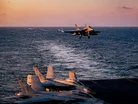
On 13 April, US President Donald Trump announced he was sending the US Navy to form a blockade of the Persian Gulf, with the intention of suffocating imports to and exports from Iran.
Since the war began in late February, with joint US-Israeli airstrikes on Iran, shipments of oil and gas leaving the Gulf have all but dried up, leaving the world without 20% of its ordinary fuel supply.
This has been a result of Iran threatening to retaliate against the US and Israel by targeting ships, but the hesitance of insurers to cover boats in the region has also played a role.
But while shipping had slowed considerably across the Middle East, reports suggest that Iranian tankers had still managed to export millions of barrels of oil through the Strait of Hormuz.
Now, with the blockade in place, Iran's ability to offload its fuel will be all but impossible.
The time for curtailment
With no obvious outlet, Iran will have wind down its oil production once it reaches its maximum storage capacity.
According to satellite data from Kayrros, Iran's storage tanks are currently just more than 51% full, meaning the country has roughly 16 days of buffer before it breaches its record storage level of 92 million barrels – a record set during the COVID-19 pandemic in 2020.
At current export levels of approximately 1.8 million barrels a day, the arithmetic is unforgiving.
Richard Bronze, Head of Geopolitics at consultancy Energy Aspects, suggests that Tehran will continue pumping for "10 to 15 days" if exports are halted, before being forced to curtail output across multiple fields.
Iran produces around 3.6 million barrels a day in total, with roughly half consumed domestically, though what it does with that other half is now an urgent question.
A war economy under strain
Iran has, until now, managed to navigate the conflict with surprising financial resilience.
Unlike its Gulf neighbours, who have seen around 350 million barrels of crude trapped since the conflict began, Tehran has continued exporting through the Strait of Hormuz throughout the seven-week war.
A temporary US sanctions waiver, granted last month to prevent a global market shock, allowed Iran to secure higher prices and, according to Iranian analysts, nearly doubled its crude revenues compared with pre-war levels – significantly above the government's 2026 budget projections.
Iran's Oil Minister, Mohsen Paknejad, said on Monday that sales had been "favourable" and that proceeds would be directed towards "reconstruction of the industry".
That waiver expires on 19 April.
Miad Maleki of the Foundation for Defense of Democracies estimates a full blockade could inflict losses of approximately US$435m a day – a figure that would rapidly erode the windfall Tehran has accumulated.
Iran's capacity to resist US pressure
The regime's determination to withstand external pressure should not be underestimated.
Sanam Vakil, Middle East Director at Chatham House, acknowledges the blockade would "put a lot of pressure" on a republic that views the war as existential, but cautions against assuming economic pain translates into capitulation.
"The mentality of the regime is one of stubborn resistance at the expense of the population, but it will come at a cost – further legitimacy crises and punishment of the people," Vakil said.
"From a psychological perspective, they can endure for a longer period than President Trump. This is a test of wills and endurance."
Richard adds a further complication: Iran is estimated to have as much as 150 million barrels already loaded on tankers outside the strait, which could allow it to maintain customer deliveries for several weeks even if new exports are halted – giving Tehran a meaningful cushion to work with whilst pursuing diplomacy.
The risk of escalation
Tehran has made clear it is not without options.
Hamid Hosseini, spokesperson for Iran's Oil, Gas and Petrochemical Products Exporters' Union, was blunt, saying: "Crude exports cannot simply be stopped."
Iranian analysts have raised the prospect of Houthi allies in Yemen being activated to disrupt Red Sea shipping, with Saeed Laylaz warning that a halt to Iranian exports could lead to the closure of the Bab al-Mandab Strait – a chokepoint through which Saudi Arabia has been rerouting a significant share of its own oil exports.

Brenda Shaffer, a Senior Fellow at the Atlantic Council's Global Energy Center, notes it has been "a surprise" that Washington did not move sooner to address Iran's grip on Hormuz shipping, but argues the shift in US strategy will make prolonging the war "less sustainable" for Tehran.
Whether the blockade holds long enough to test that thesis remains an open question.
As Richard suggests, the US "is unlikely to be able to afford to wait".
In a standoff measured in days of storage capacity and millions of barrels of floating inventory, timing may prove decisive for both sides.
Company portals



Executives

Richard Bronze
Head of Geopolitics

Sanam Vakil
Middle East Director