
Prolonged Energy Crisis on Cards as US-Iran Talks Break Down
Things have been far from quiet on the Middle Eastern front since Iran, the US and Israel agreed to a last-minute two-week ceasefire on 8 April.
Since then, Israel has continued its bombardment of Lebanon, while the Trump administration has remained infuriated by the lack of progress in the Strait of Hormuz.
Meanwhile, peace talks have taken place in Islamabad, with each of the involved parties laying out their terms for a lasting end to the war.
But after 21 hours of negotiations in the Pakistan capital on 12 April, diplomacy efforts ended without agreement. The markets have wasted little time in passing judgement.
By this morning, the price of Brent crude had risen 7% to US$102.29 a barrel and US crude jumped 8% to US$104.24, as traders digested what the breakdown in negotiations meant for a strait through which, in normal times, up to 140 vessels sail daily.
The talks, brokered by Pakistan, had been the best and perhaps only realistic near-term path to reopening the Strait of Hormuz, which has been effectively closed since the war began on 28 February with US and Israeli airstrikes on Tehran.
US Vice President JD Vance, who left Islamabad on Sunday morning, blamed the collapse on Tehran's refusal to abandon its nuclear weapons programme, while Iranian sources hit back at what they described as excessive demands from Washington.

The blockade announcement
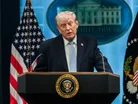
After the breakdown in negotiations, US President Donald Trump announced on Truth Social that the US Navy would begin “blockading any and all ships trying to enter, or leave, the Strait of Hormuz”.
He also added that it would destroy any Iranian mines laid in the waterway.
US Central Command followed with a formal statement, announcing a blockade of all Iranian Gulf ports and coastal areas beginning Monday at 10am ET, effectively seizing control of maritime traffic in the strait.
Lloyd’s List Intelligence reported that all traffic through the strait stopped almost immediately after Trump’s post, with two vessels that had been departing the waterway turning around.
Iran’s Revolutionary Guards warned that bringing “military vessels to the Strait of Hormuz is considered a violation of the ceasefire”. Tehran has called these proposals an “act of piracy”.
Meanwhile, the country’s Parliamentary Speaker, Mohammad Bagher Ghalibaf, took to X to taunt the US President.
“Enjoy the current pump figures,” he said. "With the so-called ‘blockade’, soon you'll be nostalgic for $4–$5 gas.”
What it means for energy markets
So, what exactly is the outlook for the global energy market?
Brent crude, which sat at roughly US$70 a barrel before the conflict began in late February, has surged as high as US$119.45 during the war before settling back to US$94.26 at the close of last week, following the short-lived ceasefire announced on Wednesday.
The announcement of a US blockade has already reversed much of that relief.
Michael Lynch, a Distinguished Fellow at the Energy Policy Research Foundation, estimates the blockade could push prices up by a further US$5 to US$10 a barrel, noting that the Iran conflict had already removed roughly 10 million barrels a day from global supply.
“This is a pretty big insult to a pretty big injury,” he says, while he also suggests the measure could prove short-lived.
“I wouldn’t be surprised to see him give it up by midweek, especially if oil prices keep going up.”
Analysts from JPMorgan, meanwhile, expect prices to remain above US$100 a barrel through the second quarter of 2026, before easing in the second half of the year.
That forecast looks increasingly optimistic given the way this week has already begun to unfold.
The wider fallout
According to industry insiders, the economic consequences look set to reach far beyond the price of oil.
The UN Development Programme warned on Monday that more than 32 million people worldwide could be pushed into poverty by the conflict’s economic shockwaves, describing a “triple shock” of rising energy costs, food insecurity and weakening growth that will fall hardest on developing nations.
Mohamed El-Erian, Adviser to Allianz and former President of Queens’ College, Cambridge, was blunt about what the breakdown means for the UK specifically.
“For the UK, all this translates into another hit to the cost of living and less flexibility for both fiscal and monetary policy responses,” he says.
The IMF and World Bank spring meetings, which opened Monday in Washington, are expected to be dominated by the conflict's impact, with the IMF's managing director Kristalina Georgieva set to present three economic scenarios – all of which predict lower growth and higher inflation.
For now, the strait remains closed, the blockade is live and the world is watching the oil price tick upwards.
Company portals





Executives

Michael Lynch
Distinguished Fellow

Mohamed El-Erian
Adviser