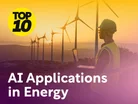
AI is becoming an increasingly crucial technology, including helping to modernise the energy sector.
It can be used to increase efficiency and safety in a company’s operations, as well as helping companies become more sustainable during the transition to cleaner energy.
Many companies are adopting AI technologies to help transform and improve their energy production and supply chains.
Energy Digital has created a list which ranks 10 of the top AI applications in the energy sector.
10. AI for cybersecurity
Company in focus: Duke Energy
CEO: Lynn Good
HQ: Charlotte, North Carolina, US

As a leading energy utilities provider in the US, Duke Energy is a target for cyberattacks. To protect itself, it has been developing AI and investing in technology for a safer and more secure energy grid.
Its AI systems can monitor network traffic and operational data to detect cyber threats or malware, faster than manual methods.
Duke Energy’s AI model can recognise unusual patterns on grid control systems that could indicate a cyber attack and trigger an immediate response.
9. Automated customer service
Company in focus: EDF Energy
CEO: Simone Rossi
HQ: London, UK
Many global energy providers are using AI-powered virtual assistants and chatbots to improve their customer service.
These AI models help answer customers’ questions about bills, outages or energy usage without waiting for a human representative.
EDF Energy has been exploring the possibilities of AI chatbots since 2018, developing a smart personal energy assistant called EVE.
EVE’s machine learning model collects information about common feedback from users and updates its understanding, helping it provide better support to EDF’s customers.
8. Supply chain optimisation
Company in focus: General Electric
CEO: Scott Strazik
HQ: Boston, Massachusetts, US

In power utility supply chains, AI can help manage scheduling of crews and equipment for grid projects.
General Electric (GE) has integrated AI in its supply chain management which has streamlined its operations, minimised disruption and reduced inventory costs by 20%.
AI-enabled route optimisation uses machine learning to calculate the real time most efficient paths for fleets by considering multiple variables and simulating different route combinations.
This application brings benefits including the ability to dynamically respond to real-world changes, mitigating risks and delays and lowering carbon emissions by planning shorter and more efficient routes.
7. Emissions monitoring
Company in focus: ADNOC
CEO: Sultan Ahmed Al Jaber
HQ: Abu Dhabi, United Arab Emirates
With sustainability as a key focus in the energy sector, AI can help provide climate solutions.
Abu Dhabi National Oil Company (ADNOC), the UAE’s state-owned energy leader, aims to achieve near-zero methane emissions by 2030.
To achieve this – and to drive change across the energy industry – ADNOC uses AI across its operations to optimise energy use and efficiency.
In 2023 this helped the company cut its carbon emissions by around one million tonnes.
AI and machine learning models can be used to track emissions data and provide suggestions for reducing a company’s carbon footprint.
6. Industrial energy management
Company in focus: Siemens
CEO: Roland Busch
HQ: Munich, Germany

AI can be used to help large industrial energy users and utilities optimise energy consumption in factories, buildings and cities.
Systems analyse IoT data and can pinpoint inefficiencies and opportunities for energy saving actions.
Siemens’ service Electrification X is used to help renewable energy operators, data centres, industries and infrastructure customers manage their energy networks.
It uses AI to provide energy and cost overviews for a company’s industrial locations as well as emissions tracking data.
Electrification X can generate a dynamic roadmap based on a customer’s specific energy, cost or emissions targets.
5. Pipeline leak detection
Company in focus: ExxonMobil
CEO: Darren Woods
HQ: Houston, Texas, US

ExxonMobil has produced an AI-enabled leak detection system in its remote pipeline segments.
It uses fibre-optic sensors and machine learning to identify leaks quickly and accurately.
These AI systems learn from historical leak data and help dynamically assess risks in real time and detect small evolving threats in the pipeline.
ExxonMobil’s system can identify key safety threats including corroded or weakened pipes in remote areas, while operating in line with strict environmental and safety regulations.
4. Power plant operations
Company in focus: NextEra Energy
CEO: John W. Ketchum
HQ: Juno Beach, Florida, US
According to the International Energy Agency (IEA), the application of AI in power plant operations could bring potential cost savings of up to US$110bn annually by 2035.
NextEra Energy is an electric power and energy infrastructure company that operates across the renewable sector.
It has worked on integrating AI into its operations, using algorithms to automatically adjust the angle of solar panels and wind turbine blades.
This helps maximise energy capture and efficiency, which has helped the company reduce maintenance costs by 25-30% and minimise equipment breakdowns by 70-75%.
3. AI-optimised energy trading
Company in focus: ENGIE
CEO: Catherine MacGregor
HQ: Paris, France
Electric utility company ENGIE signed a partnership with Google Cloud in 2022 to develop an AI-based energy solution to optimise the value of ENGIE’s wind portfolio.
The AI pilot project is focused on predicting how much wind power should be sold on which power market and at what price.
By using AI to provide a scalable data system, machine learning algorithms can forecast the state of the wind energy market.
Alexandre Cosquer, Executive Committee Member at ENGIE, says: “ENGIE has been developing its systems in the last decade to cope with the challenges involved in managing renewables assets.
“Data, digitalisation and risk management are key enablers to bring value and accelerate the decarbonisation of our power grids; in that context, a partnership with Google was obvious.”
2. Renewable energy forecasting
Company in focus: Google
CEO: Sundar Pichai
HQ: Mountain View, California, US

The unpredictable nature of wind makes turbines a potentially unreliable energy source.
Google and its AI research company DeepMind have worked on a solution using machine learning algorithms.
The project takes place by applying algorithms to 700 megawatts of wind power capacity in the US, in wind farms that are part of Google’s global fleet of renewable energy solutions.
The DeepMind system was given weather forecasts and historical turbine data to help it predict wind power output 36 hours ahead of actual generation.
The AI model then recommends optimal hourly delivery commitments for the power grid based on the predictions.
This machine learning project has increased the value of Google’s wind energy by around 20% through its scheduled energy deliveries.
Google is working to apply its cloud-based machine learning strategies more widely, helping them to be used across the renewable energy sector.
1. Predictive maintenance
Company in focus: Schneider Electric
CEO: Olivier Blum
HQ: Paris, France
Predictive maintenance uses real-time data and analytics to foresee when a machine could fail, which allows maintenance to be done in time to prevent a breakdown.
Schneider Electric provides an EcoCare Services membership which gives facilities access to advanced diagnostic tools, training programmes and support teams to help them integrate predictive maintenance into their operations.
Benefits of predictive maintenance include extending the lifespan of equipment, saving money over time due to less downtime and increasing safety and sustainability by preventing failures that could be dangerous or cause environmental harm.
Schneider Electric says that by utilising sensors and AI algorithms, companies can reduce equipment downtime by 30% and cut maintenance costs by 40%.
Olivier Blum, CEO of Schneider Electric, said on LinkedIn: “At Schneider Electric, we’re building what comes next: energy technology.
“By converging electrification, automation and digital intelligence, we’re turning energy from a background utility into a strategic asset.
“This is how we make efficiency, sustainability and resilience practical for every business, home and community.”
Company portals








Executives
Alexandre Cosquer
ENGIE Managing Director Renewables & Batteries Europe

Catherine Fiamma MacGregor
CEO

Darren Woods
CEO
Dr. Sultan Al Jaber
CEO

John Ketchum
CEO
Lynn Good
CEO

Olivier Blum
Chief Executive Officer
Roland Busch
President and CEO of Siemens AG
Scott Strazik
Chief Executive Officer
Simone Rossi
Chief Executive Officer
Sundar Pichai
CEO