
Wind energy has never occupied a more prominent position in the global energy mix than it does today.
To date, the world has surpassed 1,000GW of installed wind capacity, a milestone that would have seemed extraordinary just a decade ago.
The huge growth in wind installations is just as much a product of economics as it is environmentalism.
In most markets, wind power is now the cheapest source of new electricity generation, undercutting coal, gas and even nuclear on cost per megawatt-hour.
The pipeline of wind projects around the world vast too. From North Sea to the open plains of Inner Mongolia, new projects are being approved all the time.
In the long term, the trajectory points towards a world in which wind provides a significant proportion of all electricity – perhaps 35% by 2050, according to the IEA.
For this week's Top 10, Energy Digital shines a light on the largest, most ambitious wind farms up and running today.
10. Roscoe Wind Farm
Location: Texas, US
Company: RWE (formerly E.ON Climate & Renewables)
Built in: 2009
Peak output: 781.5MW

Few wind farms carry the symbolic weight of the Roscoe complex in West Texas. When it was completed in October 2009, it was the largest wind farm on Earth.
As is often the case in the climate tech sector, it only held the record briefly before being surpassed, but the project is still an important landmark in the story of American renewable energy.
Built across 100,000 acres of dryland cotton-farming country spanning Mitchell, Nolan and Scurry counties, its 627 turbines were a bold declaration that utility-scale wind had arrived in the US.
The site's landowners – some 400 farming families – continue to earn royalties alongside their crops, making Roscoe a celebrated example of wind energy's capacity to support rural communities.
9. Shepherds Flat Wind Farm
Location: Oregon, US
Company: Caithness Energy / GE Energy Financial Services
Built in: 2012
Peak output: 845MW
Set against the dramatic backdrop of the Columbia River Gorge in eastern Oregon, Shepherds Flat is one of the most visually striking wind farms in the US.
Developed by Caithness Energy at a cost of roughly US$2bn, the project benefited from a US$1.3 billion federal loan guarantee which was, at the time, one of the largest such guarantees ever issued for a renewable energy project.
Google's US$100m investment in the farm then attracted even more attention. That investment showed the broader market that the tech sector was interested and willing to back large-scale clean energy infrastructure – something that has become a defining trend of recent years.
The farm's 338 GE turbines spread across 30 square miles still generate enough electricity to power approximately 235,000 homes each year.
8. Hornsea 2
Location: North Sea, UK
Company: Ørsted (with AXA IM Alts & Crédit Agricole Assurances)
Built in: 2022
Peak output: 1,320MW
When Hornsea 2 was declared fully operational in August 2022, it became the world's largest offshore wind farm.
Developed by Danish energy giant Ørsted and located 89 kilometres off the Yorkshire coast, the project is a remarkable feat of engineering and resilience.
Its construction went on right through the height of the COVID-19 pandemic, with offshore teams adapting to isolation protocols and supply chain restrictions on the fly.
The farm's 165 Siemens Gamesa turbines – each capable of generating enough electricity for an entire home from a single blade rotation – cover 462 square kilometres of the North Sea.
At a project value of approximately US$3.64bn, Hornsea 2 showed that offshore wind could be delivered at scale as well as a competitive cost.
7. Muppandal Wind Farm
Location: Tamil Nadu, India
Company: Tamil Nadu Energy Development Agency (TEDA)
Built in: 1986 (ongoing expansion)
Peak output: 1,500MW
India's wind energy story has its roots in the barren coastal hills of Kanyakumari district, where the Muppandal wind farm first began generating power all the way back in 1986.
Developed by the state-owned Tamil Nadu Energy Development Agency, the site draws on the powerful winds that funnel in from the Arabian Sea through the narrow gap between the Western Ghats and the ocean.
Over the years, the site's installed capacity that has grown to 1,500MW, thanks to the thousands of turbines from manufacturers like Enercon, Suzlon and Vestas.
As such an old wind farm, many of Muppandal's first turbines are now running well beyond their intended lifecycle, and the question of replacing small, old machines with fewer, far more productive modern ones is a conversation playing out across renewable energy sectors worldwide.
6. Jaisalmer Wind Park
Location: Rajasthan, India
Company: Suzlon Energy
Built in: 2001 (ongoing expansion)
Peak output: 1,600MW
The ancient desert city of Jaisalmer is best known for its golden sandstone fort and its role on the old Silk Road. Today, it is also home to one of Asia's largest concentrations of wind turbines.
The farm has been developed incrementally by Suzlon Energy since 2001. Today, the Jaisalmer Wind Park showcases the full arc of the company's turbine portfolio, from early 350kW models to its modern 2.1MW S9X series.
It serves a wide range of customers nowadays, from private power producers to public-sector companies, and has played a formative role in shaping India's wind energy policy.
Its flat, wind-swept terrain and proximity to the northern transmission network make it strategically vital to India's renewable energy ambitions.
5. Alta Wind Energy Center
Location: California, US
Company: Terra-Gen Power
Built in: 2010–2013
Peak output: 1,550MW

The Tehachapi Pass in Kern County, California, has been synonymous with wind power since the 1980s, when it became home to some of the first commercial turbines to grace the US. The Alta Wind Energy Center (also known as the Mojave Wind Farm) is a huge part of that legacy.
Developed by Terra-Gen Power across 11 phases between 2010 and 2013 at a total cost exceeding US$3bn, it remains the largest wind farm anywhere in the US. It comprises around 600 turbines, which sit at elevations between 3,000 and 6,000 feet in the foothills of the Tehachapi Mountains, where compressed wind rushing through the pass spins the blades with impressive consistency.
The power is then delivered to Southern California Edison under a 25-year purchase agreement, where it then serves hundreds of thousands of Californian homes with clean, green electricity.
4. Hollandse Kust Zuid
Location: North Sea, Netherlands
Company: Vattenfall
Built in: 2023
Peak output: 1,500MW
Hollandse Kust Zuid holds a distinction that may seem counterintuitive in an industry that has long relied on government subsidies: it was built without any.
Swedish energy company Vattenfall won the tender for the project in 2018 with a zero-subsidy bid, betting that falling turbine costs and rising energy prices would make the project commercially viable on its own merits. That gamble paid off.
The farm, located off the Dutch coast between Scheveningen and Zandvoort, uses 139 Siemens Gamesa 11MW turbines across 225 square kilometres and supplies roughly 1.5 million Dutch households with electricity.
The farm also incorporates solar panels, floating platforms and green hydrogen infrastructure, making it a blueprint for the kind of patchwork, multi-technology offshore energy hubs that are expected to spring up across Europe over the coming decades.
3. Yangjiang Shapa
Location: Guangdong Province, China
Company: China Three Gorges Corporation
Built in: 2021–2024
Peak output: 1,700MW (Yangjiang Shapa complex, operational)
China's proficiency in offshore wind development can be seen in the Yangjiang Shapa complex in Guangdong Province, operated by China Three Gorges Corporation – the same state-owned enterprise that built the world's largest hydroelectric dam.
The 1.7GW complex, which became China's first gigawatt-scale offshore wind farm, forms the centrepiece of what is developing into a truly vast offshore cluster in the waters off Guangdong.
The broader China Three Gorges offshore portfolio across Guangdong, Jiangsu and Fujian now exceeds several gigawatts of operational capacity, with further phases in active development.
What makes this story particularly remarkable is the speed at which it has unfolded: China installed a staggering 130 GW of new wind capacity in 2025 alone, which was more than the rest of the world combined.
Today, it accounts for 77% of all new global installations and its ambition shows no sign of slowing. In the Taiwan Strait, off the coast of Chaozhou, China is planning an offshore wind farm of 43.3GW, which would make every project on this list look modest by comparison.
2. Dogger Bank Wind Farm
Location: North Sea, UK
Company: SSE Renewables, Equinor & Vårgrønn (joint venture)
Built in: 2023–2026 (phased)
Peak output: 3,600MW

When Dogger Bank is fully completed it will take the crown from Hornsea 2, becoming the world's largest offshore array. The three-phase project, which is 130 kilometres off the northeast coast of England, is being developed jointly by SSE Renewables, Equinor and Vårgrønn at a combined cost of around US$7.8bn.
The 277 GE Vernova Haliade-X turbines – the most powerful offshore turbines ever deployed, rated at up to 14MW – stand 260 metres tall and each generate enough electricity from a single rotation to power the average British home for two full days.
The project was the first offshore wind farm anywhere in the world to use high-voltage direct current (HVDC) transmission technology, allowing power to be sent ashore with minimal losses over its exceptional distance from the coast.
With all foundations installed by December 2025 and phases coming online progressively through 2026, Dogger Bank is expected to power six million British homes annually – equivalent to roughly 5% of the UK's total electricity demand. If anything captures the extraordinary pace of the offshore wind revolution, this is it.
1. Jiuquan Wind Power Base (Gansu Wind Farm)
Location: Gansu Province, China
Company: China Longyuan Power Group (lead developer)
Built in: 2009 (ongoing expansion)
Peak output: 10,000MW (operational); 20,000MW (planned)
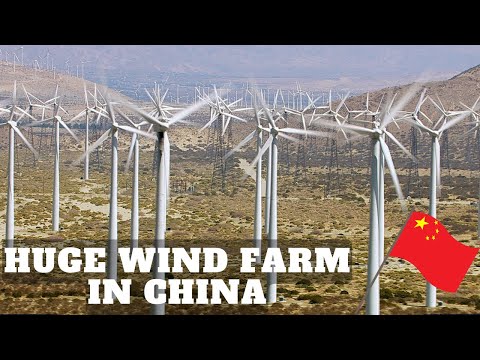
If Dogger Bank is the height of offshore ambition, the Jiuquan Wind Power Base (more commonly known as the Gansu Wind Farm) represents the full prowess of China's land-based renewable energy drive.
Spread across the arid Gobi Desert in the country's Gansu Province, the project is not a single wind farm in the conventional sense but rather a sprawling cluster of distinct installations spanning multiple provinces including Inner Mongolia, Jiangsu, Shandong, Hebei and Xinjiang.
Construction began in 2009 under the Chinese government's Renewable Energy Law, with the first 5.16GW phase completed in November 2010.
By 2021 the operational capacity had crossed 10 GW, making it by a considerable margin the largest wind power project on Earth, and the ultimate ambition remains 20,000 MW – enough to power a medium-sized European country.