
Strait of Hormuz Shut Again as US-Iran Fighting Restarts
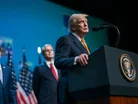
The fragile truce between the US and Iran has broken down.
Air raid sirens have sounded across Gulf states in recent days as both nations resumed hostilities following a few weeks of relative calm.
The immediate trigger came on 6 July, when Iran's Islamic Revolutionary Guard Corps (IRGC) struck three commercial vessels near Oman, including a Qatari liquefied natural gas tanker, after they reportedly ignored warnings and attempted to pass through a route lined with sea mines.
Washington responded with retaliatory strikes on Iranian military targets the following day.
Tehran answered with missile and drone attacks on Gulf military bases hosting US forces.
By 8 July, US President Donald Trump had declared the ceasefire “over”.
Iran then shut the Strait of Hormuz once again, accusing Washington of interfering with the waterway by facilitating alternative transit routes.
The oil markets react
The renewed conflict has pushed crude prices to their highest levels in a month.
Brent crude climbed to around US$85 a barrel this week, having traded near US$70 in early July following the agreement of a temporary ceasefire on 17 June.
The US benchmark, West Texas Intermediate, rose above US$80 a barrel over the same period.
Brent posted a single-day gain of 9.6% during the escalation, its steepest jump in a day since May 2020.

Vivek Dhar, Head of Commodities & Sustainability Research at CommBank, warned The Guardian that the market is entering a familiar and unwelcome pattern.
“The clock has started ticking again on global oil inventory depletion,” he said.
He also suggested that sustained conflict could send Brent towards US$100 a barrel within 10 days and as high as US$150 within ten weeks if hostilities continue unchecked.
That scenario would revive the kind of price shock last seen when fighting between the two countries first erupted in February.
Tankers caught in the crossfire
Shipping in the strait has once again become a target.
The United Arab Emirates said Iranian cruise missiles struck two of its oil tankers, the Mombasa and the Al Bahiyah, while they transited Omani waters.
One crew member was killed and eight others were wounded in the attack.
The IRGC claimed responsibility for the strike, saying the vessels had ignored repeated warnings before being disabled.
A separate incident saw a bulk carrier collide with another vessel near Qeshm Island, forcing an emergency evacuation of 23 foreign crew members, according to Iran's Fars news agency.
Trump has since said the US will maintain the strait as open "with or without Iran" and announced plans to levy a 20 percent fee on vessels transiting the waterway to cover security costs.
Iran's Foreign Minister, Abbas Araghchi, dismissed the proposal on social media.
“20% is of course too much. We will be fair,” he wrote.
The International Maritime Organization pushed back on the idea of unilateral tolls altogether, stating that passage through the strait “should remain free of any tolls and charges, in accordance with international law”.
A different kind of war
Energy infrastructure has so far been spared the worst of the fighting this time around.
That marks a notable shift from the opening weeks of the conflict in February and March, when US and Israeli strikes targeted Iranian energy facilities directly and Iran responded by bombing oil and gas installations across the Gulf.
Several regional airports were forced to suspend operations during that earlier phase.
The current round of strikes has instead concentrated on military assets, coastal defence systems and vessels linked to shipping disruption in the strait.
Analysts note that both sides appear to be testing the limits of what the other will tolerate rather than pursuing the broader war aims seen earlier this year.
Paul Musgrave, Associate Professor of Government at Georgetown University in Qatar, told Al Jazeera that Washington's objectives have narrowed considerably since the conflict began.
He noted that talk of regime change has faded from the American side even as some voices in Tehran now speak of asserting greater influence across the Gulf.
What it means for energy markets
For an industry still recalibrating supply chains after the initial outbreak of fighting, the return of hostilities is a stark reminder of how quickly Gulf risk can resurface.
Shipowners, insurers and buyers of Gulf crude and LNG now face fresh uncertainty over transit costs, security and the reliability of the strait itself.
With diplomacy continuing in parallel through Qatari and Pakistani mediation, the coming days are likely to determine whether this remains a contained exchange or escalates into something closer to the sustained conflict seen at the start of the year.
Company portals


Executives

Paul Musgrave
Associate Professor of Government

Vivek Dhar
Head of Commodities & Sustainability Research