
Strait of Hormuz Set to Reopen as US-Israel-Iran War Ends
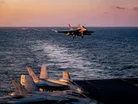
A framework deal to end the months-long conflict between the US, Israel and Iran has been reached, with the Strait of Hormuz expected to reopen and oil prices already tumbling in response.
The announcement came late on Sunday 14 June, when Pakistani Prime Minister Shehbaz Sharif confirmed that Washington and Tehran had agreed to end hostilities on all fronts.
Minutes later, US President Donald Trump posted on Truth Social, writing: "The Deal with the Islamic Republic of Iran is now complete."
Iran's Deputy Foreign Minister, Kazem Gharibabadi, confirmed the deal on state television, saying it put an "immediate end" to the war.
The conflict began on 28 February 2026, when US and Israeli forces launched coordinated strikes on Iran.
Tehran's response included the effective closure of the Strait of Hormuz, the world's most critical oil shipping chokepoint, through which roughly 20% of global crude supply transits.
The formal signing ceremony is scheduled for Friday 19 June in Switzerland.
What the deal actually says
The memorandum of understanding (MoU), as reported by Iranian state media agency Mehr News, is a 14-point document covering a ceasefire extension, Hormuz reopening procedures and the outline of a 60-day negotiation period.
The immediate objective is to extend the two-week ceasefire agreed on 8 April by a further 60 days.
During that period, Iranian forces will be responsible for clearing the strait of sea mines for the first 30 days.
No tolls would be charged to vessels during the 60-day period, and the US plans to lift its naval blockade of Iran, allowing the Persian Gulf nation to resume exports.
Iranian state media reported that the MoU also stipulates the release of US$24bn in frozen Iranian assets during the negotiation period.
Trump insisted the strait would be "permanently toll free", though Iran's Mehr agency described the reopening as taking place under "Iranian arrangements" – a divergence that analysts say underlines the fragility of the framework.
The BBC’s Chief North America Correspondent Gary O'Donoghue noted that the deal is "just a beginning", with 60 days during which the US and Iran will need to agree on the destruction and removal of Iran's nuclear material.
Oil prices fall, markets surge
Though the deal was only announced late on 14 June, the markets have responded swiftly.
The price of Brent crude fell more than 4% to around US$83.60, while West Texas Intermediate approached US$80 a barrel for the first time since early March.
Asian equities surged, with Japan's Nikkei 225 closing up 5% and South Korea's Kospi rising 4.8%.
In Europe, Germany's Dax and France's Cac 40 each gained around 1.7%, while London's FTSE 100 rose a more modest 0.6%, with BP and Shell shares falling around 4% on the back of lower oil prices.
Tamas Varga, an Analyst at PVM Oil Associates, said the two major crude benchmarks had already lost almost US$6 per barrel over the previous week, with a further US$4 shed overnight.
"The pre-crisis status quo may never be fully restored, or at least not for a long time, but the most pressing issue, the resumption of oil and other commodity flows, appears likely to be resolved in the foreseeable future," he said.
Elsewhere, Matt Britzman, Senior Equity Analyst at Hargreaves Lansdown, told the BBC that global equity markets were "starting the week firmly on the front foot", adding that the framework deal had "given investors a clear reason to dial back some of the geopolitical risk premium that has hung over markets".
When will the Strait of Hormuz fully reopen?
The closure of the Strait of Hormuz has been hugely disruptive to the global energy sector.
President Trump, who had been under enormous pressure to facilitate the resumption of trading through the strait, took to Truth Social after the peace deal was announced to discuss the strait.
"I hereby fully authorise the toll free opening of the Strait of Hormuz, and, simultaneously herewith, authorise the United States Naval blockade. Ships of the world, start your engines. Let the oil flow!"
While the President's message appeared quite unequivocal, some experts warn that the process of reopening the strait will take time.
A retired US Navy rear admiral, Mark Montgomery, told BBC Radio 4's Today programme that mine clearance in the Strait could take "weeks to months", and that it could take up to two months for the world to feel full relief from the restriction on oil exports once traffic resumes.
He added that there could be some "obvious relief" within a week, but full unrestricted transit without naval escorts conducting constant route clearances would take considerably longer.
Nevertheless, the reaction of politicians around the world has been positive.
The UK’s Prime Minister, Sir Keir Starmer, described the deal as a "hugely significant moment", saying it was "vital that all parties seize this opportunity to secure stability in the region and restore freedom of navigation in the Strait of Hormuz".
Ursula von der Leyen, the President of the European Commission, echoed these sentiments, saying that the agreement opened "the door to broader negotiations on peace and security in the Middle East", while she also called for the "immediate reopening" of the strait.
What does Israel’s position on Lebanon mean for the deal?
While the deal should lead to a cessation of fighting between the US, Israel and Iran, the situation regarding Lebanon is less certain.
Israel began attacks on Lebanon shortly just a day after its first strikes hit Iran. Israel has continued to bombard Lebanon ever since, with airstrikes in Beirut killing three people and injuring a further 15 just yesterday.
When Pakistan – the main mediator of the negotiations – announced the agreement of the peace deal, its diplomats stipulated the "immediate and permanent termination of military operations on all fronts, including in Lebanon".
However, Israel was excluded from these negotiations and has yet to show signs of compliance.
Israel's Defence Minister Israel Katz said the IDF would remain in "security zones" in Lebanon, Syria and Gaza "without time limit", adding that "all terrorist infrastructures" would be destroyed.
Far-right National Security Minister Itamar Ben-Gvir said Israel was "not partners to this agreement" and that it did "not bind us in any way", insisting the country "must not settle for anything less than the dismantling of Hezbollah".
The stakes for Lebanon are huge. More than 3,700 people have been killed since the war began, around 5% of the country's territory is under Israeli occupation and one million people are currently displaced.
Iran's Foreign Minister, Seyed Abbas Araghchi, said he had spoken to counterparts in Turkey, Iraq and Egypt about the need for a "complete halt" to Israeli attacks in Lebanon.
Whether or not the continuation of attacks in Lebanon affect Iran’s involvement in the peace deal remains to be seen.

The long-term implications for the energy sector
OPEC's latest monthly oil market report, released before the deal was announced, painted a picture of a severely tight market.
Global oil demand growth for 2026 was revised down to 930,000 barrels per day from 1.15 million barrels per day in May, with elevated prices blamed for the revision.
Tamas Varga suggests that even if the flow of oil resumes, the situation will continue to be precarious.
"It is far from a dream scenario, but it might not matter," he says. "They have generously overlooked forecasts over the past three months, and if traffic through the Strait really starts flowing freely again, the upside will be very limited," he said.
Company portals





Executives

Matt Britzman
Senior Equity Analyst

Tamas Varga
Analyst