
What Does Iran's Attack on QatarEnergy Mean for Gas Prices?
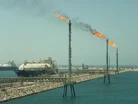
Iranian missiles struck and severely damaged Qatar's Ras Laffan Industrial City overnight – a facility that is responsible for producing 20% of the world's liquefied natural gas (LNG).
Ras Laffan is, by some distance, the world's largest production hub for LNG. As such, the effects of this attack – and the disruptions to global gas supplies that will inevitably follow – will be felt the world over, from boardrooms to boiler rooms.
The complex is run by state energy company QatarEnergy and hosts operations from some of the world's largest energy firms, including Shell, ExxonMobil and Chevron.
QatarEnergy today confirmed that two missile strikes had landed on the site – one causing "extensive damage" to Shell's Pearl gas-to-liquids facility and a second triggering what it described as "sizeable fires and extensive further damage" to several of its LNG facilities.
Critically, according to Rystad Energy's SVP Aditya Saraswat, the strikes have knocked out the LNG processing lines that supply Europe, Japan, South Korea and China under long-term contracts.
Production at Ras Laffan had already been suspended since early March, shortly after the conflict between the US-Israeli coalition and Iran began, but the physical destruction of infrastructure now raises far more serious questions about when, if at all, supply can be restored at scale.

How the markets responded
The market reaction on Thursday morning was swift and significant.
UK natural gas prices briefly surged by more than 30% when trading opened, before settling at around 170 pence per therm (100 cubic feet of gas) – still around 22% above the previous close.
European gas prices jumped from €55 per MWh to €72/MWh, a rise of around 35%.
Oil surged too, climbing roughly 8% to US$116 a barrel – a striking move given that it was trading at just US$65 only weeks ago.
Matthieu Favas, Commodities Editor at The Economist, described the price rise as "huge", though he notes that prices remain well below the peaks seen in the wake of Russia's invasion of Ukraine in 2022.
Natasha Fielding, who leads on gas and LNG for commodities specialist Argus Media, was less sanguine, warning that "if there is long-term damage to the LNG facility – which we still do not know – then it would not be surprising to see prices at the European benchmark push significantly higher".
"They could get closer to the eye-watering heights in the 2022 energy crisis," she adds.
A moment that 'defies historical comparison'
Until this week, the working assumption across energy markets had been that disruptions to Qatari LNG supply would prove relatively short-lived.
Energy research firm Wood Mackenzie has now abandoned that view entirely, saying the attacks "fundamentally reshape global LNG outlook" with the recovery timeline "likely significantly extended."
Kristy Kramer, Head of LNG strategy and market development at Wood Mackenzie, was blunt: "Market expectations had been for a short disruption, with a controlled restart restoring supply to pre-conflict levels by mid-2026. That outlook now appears increasingly unlikely."
Elsewhere, Seb Kennedy, Founder of gas and LNG analytics platform Energy Flux, went even further. He argued that "rapid escalatory attacks and destruction of critical energy infrastructure are on a scale that defies historical comparison," adding that "this spiralling conflict is sowing the seeds of an energy crisis that will dwarf the events of 2021-22".
From trading floors to boiler rooms
For consumers, the journey from Middle Eastern conflict to household energy bill runs through a regulatory mechanism that has long frustrated critics of UK energy pricing.
Ofgem uses gas as the so-called marginal source of power, meaning it effectively sets the wholesale price of electricity across the entire grid regardless of how that electricity is generated – a quirk that leaves even households powered by renewables or nuclear exposed to gas price shocks.
In 2022, the typical annual household energy bill soared from £1,277 to £3,549 in a matter of months, with the government ultimately stepping in to cap average bills at £2,500 – a cost absorbed through taxation that has weighed on public finances ever since.
Ashley Kelty, an Analyst at Panmure Liberum investment bank, warns that the current crisis could prove even more disruptive.
"There is a huge risk of shortages – northwest Europe could run out of gas as storage is very limited and competition from Asia means LNG cargoes will be diverted at the least," he explains. "Load-shedding and even blackouts in the summer no longer look fanciful."
At the forecourt, Greg Newman, Founder and CEO of London-based oil and energy derivatives trader Onyx Capital, predicted diesel prices could hit £2 (US$2.68) a litre as early as next month.
"What is concerning for the UK is that European oil prices, which were lagging behind the Middle East and Asia, are now aggressively catching up – and there is a long way to go for prices just to align with the rest of the world," he says.
Nick Butler, the former Head of Strategy at bp and one-time adviser to UK Prime Minister Gordon Brown, has been equally stark.
"This will almost certainly cut off a level of supply of LNG to the world market," he says. "The price of gas in the world market will therefore inevitably rise, because that gas can't be substituted very quickly at all, and maybe not for a very long time."
Whatever fiscal response the government ultimately reaches for, it will do so with public finances already bearing the scars of 2022.
Chancellor Rachel Reeves has said "nothing is off the table" – but with the cost of the last round of support still being felt, the room for manoeuvre is narrower than it was.
Company portals








Executives

Amir Zaman
Head of the Americas Commercial Team

Ashley Kelty
Analyst

Greg Newman
Founder & CEO

Kristy Kramer
Head of LNG Strategy & Market Development

Nick Butler
Former Group VP for Strategy & Policy

Saad al-Kaabi
CEO