By now, almost every company – regardless of sector – is beginning to introduce AI into their operations. In 2026, conventional wisdom suggests that any business still hesitating on AI is being left behind.
One particularly practical subset of AI is machine learning. Unlike large language models like ChatGPT and Gemini, machine learning programmes are long-term projects which use a company’s data to learn and refine themselves over time.
This kind of iterative improvement makes machine learning platforms especially well suited to industries like energy, where operations are constant and data sets are unfathomably large.
But what exactly can machine learning bring to the modern energy firm?
Some of its current use cases include optimising grid loads and predicting equipment failures before they even occur.
Looking ahead, though, there is no telling how far machine learning could take the sector. In fact, many tech and energy companies alike believe that machine learning could be the thing that helps society achieve net zero and stave off the worst effects of climate change.
In this week’s Top 10, Energy Digital takes a look at some of the most impressive machine learning (ML) platforms currently available to the world’s energy firms.
10. Uptake
Founded: 2014
HQ: Chicago, Illinois, US
Notable feature: Predictive asset health scoring across wind, solar, and gas fleets

Uptake has carved out a strong niche for itself in industrial AI, with a particular focus on helping energy operators extract meaningful intelligence from machine data.
Its platform is able to ingest data from turbines, compressors and grid assets, which it then uses to flag anomalies and recommend actions before systems fail.
For utilities that are managing tired, ageing infrastructure, Uptake's model can provide a low-friction entry point into the world of machine learning.
9. Avathon
Founded: 2013
HQ: Austin, Texas, US
Notable feature: Darwin AI – an automated machine learning engine built for industrial time-series data

Avathon (the company formerly known as SparkCognition) brings a vast portfolio of industrial AI models to the table.
Its suite of solutions span everything from predictive maintenance, cybersecurity and language processing.
The Darwin AI engine is the jewel in the crown. It is capable of automating the process of actually building models, which makes it accessible to asset managers who lack deep data-science know-how.
8. Envision Digital
Founded: 2019
HQ: Singapore
Notable feature: AIoT OS – an operating system purpose-built for connected energy assets

Envision Digital occupies a distinct position at the crossroads of energy and ML.
As a platform created by one of the world’s largest wind turbine manufacturers, it has deep, arcane knowledge baked directly into its algorithms.
Its AIoT operating system can aggregate data from renewable assets, buildings and grid infrastructure across one single interface, allowing operators to monitor the performance of their assets and optimise accordingly.
It has been taken up particularly enthusiastically across the Asia-Pacific region, where the rapid rollout of renewables has led to a huge demand for intelligent asset management tools.
7. Fractal Analytics
Founded: 2000
HQ: San Jose, California, US
Notable feature: Asper – an AI-powered demand forecasting and energy trading analytics suite

Fractal Analytics’ background is in data science consulting and that shows in how it approaches the energy sector.
The firm’s Asper platform is built for the sharp end of energy trading and demand planning, using ML models to produce forecasts across short-term, medium-term and long-term horizons.
Utilities and energy retailers have used Fractal's tooling to meaningfully cut forecast errors, which translates directly into lower balancing costs.
Its consulting roots also mean clients get hands-on support when deploying the models.
6. Rebase Energy
Founded: 2017
HQ: Gothenburg, Sweden
Notable feature: High-resolution renewable energy forecasting using numerical weather prediction integrated with ML
Rebase Energy, which used to be known as Greenlytics, is a Swedish AI start-up steeped in the renewable energy sector.
Its forecasting platform is built specifically for wind and solar operators who need site-specific analytics.
It achieves this by combining weather forecasting models with neural networks trained on years of data from renewable generators.
The result is a set of predictions that help traders and grid operators get a handle on uncertainty.
5. GridBeyond
Founded: 2014
HQ: Dublin, Ireland
Notable feature: Point – an AI-powered energy intelligence platform that optimises commercial and industrial assets across multiple electricity markets simultaneously
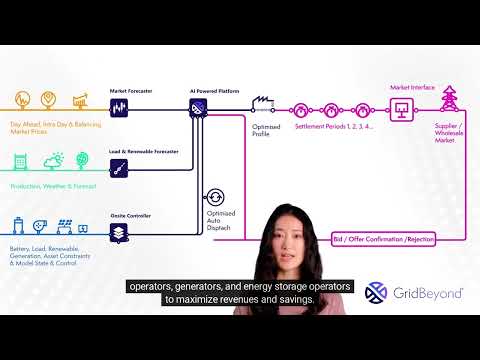
GridBeyond's ML platform is built around the idea that commercial and industrial energy assets like batteries and generators are worth far more when an intelligent system is managing them across multiple markets at once.
Its Point platform does exactly that, using machine learning to dispatch assets across day-ahead, intraday and balancing markets in real time, continuously learning which strategies generate the most value.
A €52m Series C funding round in 2024, backed by the likes of ABB and Constellation, was a strong signal that the industry agrees. With its load portfolio now exceeding 2.6 gigawatts, GridBeyond has the scale to keep improving its models at pace.
4. C3.ai
Founded: 2009
HQ: Redwood City, California, USA
Notable feature: C3 AI Reliability – a suite of pre-built applications for energy asset predictive maintenance

C3.ai is one of the best-known names in enterprise AI, and the energy sector is one of its strongest markets.
Its machine learning models cover everything from predictive maintenance to emissions monitoring.
What’s more, as pre-built platforms, companies do not have to worry about building from scratch.
C3’s technology is already integrated with Microsoft Azure and Google Cloud, which gives it some serious, enterprise-grade credentials.
3. Uplight
Founded: 2019
HQ: Boulder, Colorado, USA
Notable feature: Orchestrated Energy – a machine learning platform for personalised utility customer engagement and demand-side management

Uplight sits at an interesting crossroads between machine learning, behavioural science and the energy transition.
Born from the merger of several established energy software firms, it now serves more than 80 utilities across North America.
Its Orchestrated Energy platform uses ML models to identify which customers are most likely to respond to demand response events, helping utilities shave peak load without building a single new power plant.
As the electrification of heating and transport causes grids to strain, that kind of demand-side intelligence is only going to become more and more valuable each year.
2. Cognite
Founded: 2016
HQ: Oslo, Norway
Notable feature: Cognite Data Fusion – an industrial DataOps platform that contextualises operational data for ML applications

Cognite has made a name for itself by solving one of the energy sector's most stubborn problems: siloed data.
Its Cognite Data Fusion platform pulls together data from historians, SCADA systems and engineering documents, organising it into a coherent knowledge graph that AI tools can actually work with.
Major operators like Aker BP and TotalEnergies have already deployed it at scale and have seen the results that come from finally being able to put their data to work.
1. Zeitview
Founded: 2015
HQ: San Francisco, California, USA
Notable feature: AI-powered aerial inspection platform using computer vision to detect faults across solar, wind, and transmission infrastructure
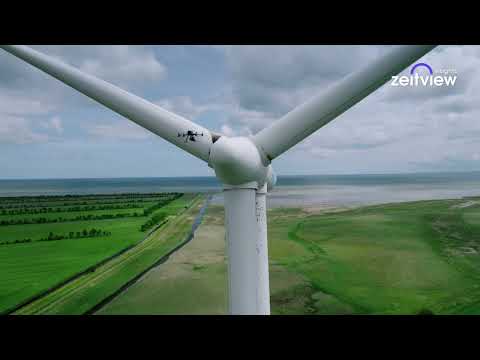
Zeitview has built something genuinely compelling: a computer vision platform that inspects energy assets from the air at a pace and scale that no ground-based team could hope to match.
Its software processes drone and aerial imagery from solar farms, wind turbines and power lines, automatically spotting faults, from cracked photovoltaic cells to blade erosion. Then, it ranks them by severity.
With hundreds of gigawatts of assets inspected globally, Zeitview's models are trained on a dataset that no competitor can easily replicate, and they get a little smarter with every job they complete.