Fluor, Shell & OVO: This Week's Top Five Energy Stories
1. Why Fluor is Building the US's First New Refinery Since 1977
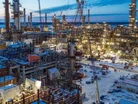
Fluor Corporation has been awarded the contract to engineer and design a large-scale refining facility in Texas, the first in the US in half a century
The energy crisis engendered by the ongoing conflict in the Middle East has left governments globally considering their energy security.
In many cases, this period of reflection has led to the conclusion that countries need to rely less on global trading partners when it comes to fuel, due to the current instability of the oil and gas market.
While the US's military involvement in the Middle East may have negatively impacted its own energy economy in the short term, US President Donald Trump has made repeatedly clear his desire to move away from a globalised energy sector.
Since Trump was inaugurated for a second time in January 2025, he has spoken time and again about increasing US oil drilling.
While some progress has been made against this goal, refining remains something of a problem for Trump's ambition for the US to become self-sufficient.
The US is one of the world's most prolific refiners of oil, yet it still relies somewhat on importing fuel due to bottlenecks at its 130 refineries.
Part of this is down to the fact that the country has not built a new oil refinery in almost 50 years. This, however, is about to change
2. Why is Shell Selling All its Service Stations in France?
Shell has made plans to sell its French petrol stations as the firm’s strategy shifts, raising questions over retail margins and its post-war priorities
Shell is preparing to sell its entire network of petrol stations in France, according to a report from French news outlet Les Échos.
The company is seeking a buyer for its portfolio of around 60 service stations, with a deal expected to be agreed by the third quarter of 2026 and completed in early 2027.
The assets, which generated operating profits of roughly US$127.5m in 2025, might appear modest within Shell’s global portfolio, yet they remain a profitable foothold in a competitive downstream market.
Crucially, Shell does not directly own these sites, instead operating through concession agreements with motorway operators including Vinci, Cofiroute and ASF.
That structure has long limited control while tying the business to fixed-term contracts and periodic competitive tenders.
So, what is the rationale behind this decision?
Despite the profitability of Shell’s sites in France, the stations sit within a structurally constrained segment of the downstream sector.
A significant share of earnings comes not from fuel sales but from retail activity, including food and beverage purchases that drive margins in roadside convenience.
This reflects a broader industry reality in Europe, where fuel retail margins are thin and increasingly sensitive to price competition from supermarkets.
In France in particular, hypermarkets dominate fuel sales, often undercutting traditional operators and compressing returns.
3. The Fall of OVO: Why the 'Big Six' Firm is Selling to E.ON
E.ON’s planned acquisition of struggling OVO could further consolidate the UK energy sector, with the former positioning itself to compete with Octopus
If you follow the English Premier League, you’ll be familiar with the concept of the “Big Six” – the group of clubs considered the most prestigious in the country.
That, however, is not the only illustrious sextet in the UK.
For decades, the British energy sector has had its own Big Six, made up of the energy providers with the largest market shares across the UK.
For years, the pre-eminent forces in the country’s gas and energy sector were EDF, E.ON, British Gas, npower, Scottish Power and SSE, though, as is the case in football, the supremacy of these leaders is never quite set in stone.
More recently, the make-up of the Big Six has shifted, following some meteoric rises and strategic acquisitions.
E.ON acquired npower in 2019, while newcomers OVO and Octopus rose to prominence, with the former buying out SSE’s retail arm in 2020.
Now, after a few years of stability, the tectonic plates beneath the UK’s energy landscape appear to be moving once again, following the huge news that E.ON is planning to acquire OVO imminently.
4. Moment Energy: The World's Largest EV Battery Upcycling Site
Moment Energy is building a 1GWh second-life EV battery repurposing megafactory in Vancouver, targeting AI, data centres & energy storage demand across NA
Canadian clean energy firm Moment Energy has announced it will complete what it claims will be the world's largest battery repurposing facility in Vancouver, British Columbia, within the next six weeks.
The facility, which the company is calling a "megafactory", is expected to be fully operational by the end of June.
The announcement follows a US$40m Series B funding round, bringing total capital raised for the project to more than US$100m.

That impressive figure speaks to the ever-growing appetite for energy storage technology, even if questions remain about the pace at which supplies of second-life batteries can be rolled out.
"This is about building the infrastructure needed to support the next generation of energy demand," says Edward Chiang, the Co-Founder and CEO of Moment Energy.
"We are proud to establish this facility in Canada, the country where Moment Energy was founded, to foster domestic manufacturing.
"This scaling solution utilises existing battery resources to deliver the reliable, affordable power that is so crucial right now," he adds.
5. How Aramco Posted Huge Profits Despite the Hormuz Closure
Saudi Aramco saw a 25% jump in year-on-year profits for Q1 despite disruptions in the Middle East, with price spikes and its East-West Pipeline to thank
Few companies are more central to how the world powers itself than Saudi Aramco.
In the century since its founding, it has become, by almost any measure, the most consequential energy business on the planet.
It is the largest oil and gas producer in the world, with a production volume of 12.4 million barrels of oil equivalent per day in 2024, and its 4.1 million barrel per day net refining capacity makes it the world's fourth-largest refiner.
However, when joint US-Israeli strikes on Iran kickstarted conflict across the Middle East at the end of February, the company's operations were immediately impacted.
While Saudi itself has not joined the fighting, its supply line through the Strait of Hormuz (the waterway through which the vast majority of Middle Eastern oil and gas ordinarily passes) has been effectively closed, leaving the country without its go-to trade route for its number one export.
The consequences for global supply chains have been severe. Over the past two months, an estimated one billion barrels of oil have been removed from global markets, according to executives from the world's biggest oil companies.
But despite all the upheaval, Aramco has just posted a 25% jump in profits for the first quarter of 2026.
The question, then, is how has Aramco offloaded its products since the war began? And more to the point, what is the company's strategy going forward, should disruption continue to rule the region for the foreseeable future?