Trump Pays Duke Energy US$129m to Scrap its US Wind Projects
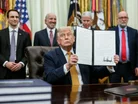
Duke Energy, one of the US’s premier energy providers, has agreed to scrap its plans to build a wind farm off the coast of North Carolina following discussions with the Trump administration.
Duke has accepted a settlement of US$129m from the White House with the proceeds expected to go instead towards investments in nuclear power and natural gas, as well as upgrades to the grid.
The termination of the company’s offshore wind lease is just the latest scalp of US President Donald Trump’s campaign against wind energy, which has already seen TotalEnergies axe its plans for two arrays on the Eastern Seaboard.

The US Government’s war on wind
The agreement, announced by Interior Secretary Doug Burgum on 29 June, covers Duke's Carolina Long Bay lease, a site located around 22 miles south of Bald Head Island in Brunswick County.
The site had been earmarked to generate enough electricity to power more than 300,000 homes.
Under the terms of the settlement, Duke has agreed to relinquish the lease and reinvest an equivalent sum into other projects in the Carolinas.
The deal is the fourth of its kind struck by the Trump administration since taking office.
As well as the deal with TotalEnergies in March (which saw the White House pay compensation of around US$1bn), Trump has paid settlements to Ocean Winds and Invenergy, to the tune of US$885m and US$765m respectively.
What Duke has lost
Duke's Carolina Long Bay lease sits just across from the TotalEnergies site that was itself cancelled earlier in the year.
In fact, both plots were auctioned at the same time in 2022 as part of a federal leasing round.
But while it appears that the Trump administration has strong-armed Duke into giving up its lease, reports from the Carolina Journal suggest that the company’s position on offshore wind had already been shifting.
In filings with the state government, Duke concluded that offshore wind was not currently the most reliable or cost-effective energy source, citing rising project costs, lengthy development timelines and rapidly growing electricity demand driven by population growth and new industrial activity.
The administration's position
In his announcement, Doug Burgum offered an enthusiastic defence of the agreement with Duke.
"President Trump's vision of unleashing affordable, reliable American energy for our country's communities and using common sense to put the American people first is being implemented," he said.
"Duke Energy will now be able to convert a national security concern into projects that will lower the costs for its customers in North Carolina and surrounding states."
On the other side of the table, Kodwo Ghartey-Tagoe, the EVP and CEO of Duke Energy Carolinas, saw the deal in similar terms.
"This settlement allows Duke Energy to refocus US$129m in ways that directly benefit our customers and communities in the Carolinas," he said.
"Under the agreement, Duke Energy will reinvest nearly US$129m in additional generating capacity, which may include advancing new nuclear and natural gas generation, and grid enhancements to strengthen reliability, support continued growth in the Carolinas and keep costs as low as possible."
According to reports from Bloomberg, Duke will expect to reallocate these funds by the end of the year.
A growing pattern
Trump 2.0’s distaste for wind energy first became apparent on the campaign trail. It was quickly actualised with a slew of executive orders and federal injunctions.
Today, after some mixed results, Trump’s approach appears to have evolved into something a little more transactional.
When, on the first day of his second term, he signed an order that called for an indefinite halt to new wind farm approvals, federal courts repeatedly thwarted its enforcement.
A subsequent attempt to suspend construction on projects already under way on national security grounds was similarly met with injunctions.
But by buying out companies’ leases, the administration has found a way to sidestep the courts entirely.
The cumulative impact of these deals is enormous. According to journalist Adrijana Buljan, the government has paid somewhere in the region of US$2.7bn in lease buyouts this year alone.
More settlements on the horizon
European renewables giant RWE has already made clear it expects to be fully reimbursed for the more than US$1.2bn it paid for three leases off New York, California and the Gulf of Mexico, with its CEO warning that legal action remains on the table if reimbursements are not forthcoming.
Meanwhile, the German company received an open letter from a group of around 50 US organisations imploring it not to meet Trump’s demands.
“We urge RWE not to cut deals with a regime that has no respect for either legal norms or climate reality,” the letter read.
“The Trump administration will not last forever. Submitting to its fossil fuel whims sets a dangerous precedent and exposes RWE to serious reputational risk.”
The letter raises an interesting question. If, as the client, the American Government no longer wants renewable energy projects, where does that leave the energy companies?
Are they obliged to direct their compensation into fossil fuel projects, or can they exercise their own free will?
Speaking with Energy Digital earlier this year, Serene Hamsho, the Founder and President of the Offshore Wind Academy, discussed the Trump administration’s campaign on wind and the consequences for the market.
“It’s a significant setback for the US market in the short term, and I won’t pretend otherwise,” she said.
“When a major developer accepts a billion dollars to walk away from its US offshore wind portfolio, that signals a policy environment where long-term investment confidence has eroded.
“Capital and talent will go where the conditions are right,” she continued.
“What the US risks is falling behind in an industry it was well-positioned to lead, and that’s a real cost that will be felt in jobs and in the energy mix for years.”





Executives

Kodwo Ghartey-Tagoe
EVP and CEO of Duke Energy Carolinas

Markus Krebber
CEO
Patrick Pouyanné
Chairman and CEO

Serene Hamsho
President & Founder